As we approach the 50th anniversary of the first women Rhodes Scholars, a look much further back at three remarkable women associated with the Trust in different ways.
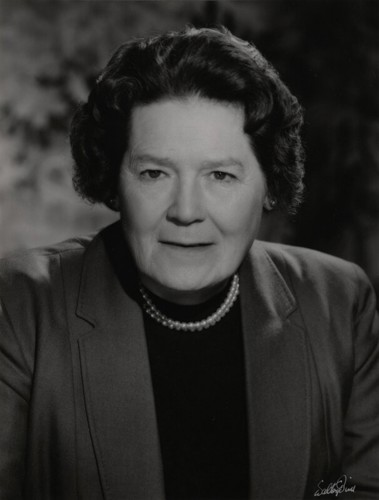
Margery Perham
In the early years of the Rhodes Trust, the Trustees made several grants to Rhodes Travelling Fellows, funding Oxford academics to travel abroad for their research. Perhaps the most prominent of these was Margery Perham who was funded for two years from 1929 to study the British treatment of African populations.
Perham was born in Bury in 1895 and won a history scholarship at St Hugh’s College, Oxford before becoming an assistant lecturer in history at the University of Sheffield. During this time she took a year’s leave due to illness, spending this in Somaliland, beginning a lifelong interest in the British African colonies.
She returned to St Hugh’s in 1924 and was encouraged to apply for the Rhodes Travelling Fellowship by Barbara Gwyer, Principal of St Hugh’s. Sir Anthony Kenny’s The History of the Rhodes Trust records:
The Trustees were proud of the work she produced, and when Sir Edward Grigg protested to the Trustees about some of her statements about East Africa, they rebuffed his choleric complains. Rhodes travelling fellows were responsible for their own opinions, which were not necessarily those of the Trustees.
Perham’s work on British colonialism was hugely influential: in 1939 she was appointed the first Fellow of Nuffield College and her books, reports and papers provided the basis for the Oxford Institute of Colonial Studies, to which she was appointed director. In 1961 she became the first woman to deliver the Reith Lectures; her topic was The Colonial Reckoning, and the BBC has recordings of two of the six lectures available online.
Perham’s connection to Rhodes House remained strong. She described how the offer of a second year’s fellowship “changed my life… and started a rather precarious but enthralling career in the study of Africa.”
When she died in 1982, her papers were donated to the Rhodes House Library. In July 1989 a seminar was held at Rhodes House to celebrate the completion of the cataloguing of the seven hundred boxes of these papers by Patricia Pugh, and to assemble, as a help towards a biography, some of those who had known Perham as colleagues, assistants and friends. The papers from this seminar were published in The Journal of Imperial and Commonwealth History in 1991, and Perham’s papers are now held by the Bodleian Library.
During the Second World War, the Rhodes Scholarships were suspended and the Trustees received several suggestions for replacements. While most of these requests were rejected, in 1940 the Trustees did grant £1,000 to offer scholarships at Oxford for Chinese or Chinese British subjects who had graduated from Hong Kong University and whose studies were disrupted by the war.
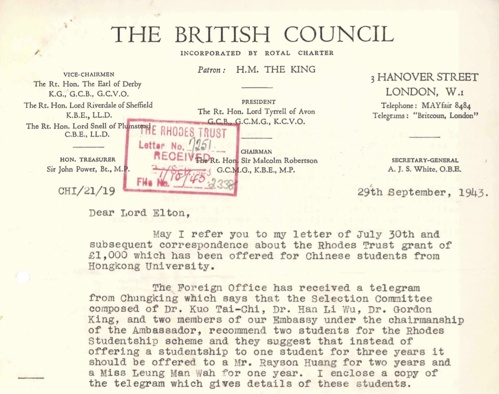
These were advertised in 1941 as “Rhodes Trust Postgraduate Studentships,” but it was September 1943 before a selection committee was convened at Hong Kong University. The committee chose two students – Rayson Huang (who went on to become the first Chinese Vice Chancellor of Hong Kong University) and Man Wah Leung; they arrived in England in 1944.
Letter from British Council to Rhodes Trust, courtesy of Rhodes Trust Archives
At this point, the story becomes less clear. The scholarships were funded in partnership with the British Council who incorrectly announced these as “Rhodes Scholarships”, and the Trust’s archives contain letters from the Secretary to the Trustees, Lord Elton, admonishing the Council for repeating this mistake in later communications.
Man Wah had arrived hoping to study for a Diploma in Education, a course that was not offered by Oxford. She was therefore asked to transfer to a British Council scholarship and study in London but refused before eventually switching to study PPE at St Hilda’s College, Oxford. But an alternative version of this story suggests that she was denied a Rhodes Scholarship because she was a woman, and women were not eligible for the Scholarship. The Trust’s archives offer no evidence to support this version of events, but are somewhat ambiguous about why she could not have used the Rhodes funding to study in London.
After completing her PPE degree in 1946, Mah Wah married Arthur Bentley, a friend of Rayson Huang who had been the university pharmacist in Hong Kong. The Trust holds no records of her time after Oxford; we know what follows from a chapter she contributed to Dispersal and Renewal, an obituary published by St Hilda’s College, and a chapter by Julia Ching in the 2003 anthology, The Best Teacher I Ever Had.
Man Wah returned to Hong Kong teaching at her old university, and in 1948 founded the St Joan of Arc Evening School, which is now the St. Joan of Arc School. By 1971 she had returned to England, teaching Philosophy and Logic at St Maur’s Convent (1971-74) and Philosophy and Politics at Rosslyn House (1977-79). She was awarded a PhD in Philosophy from the University of Sussex in 1981. She died in 2007.
For many years, the Trust had incorrectly recorded Man Wah as a Rhodes Visiting Fellow – we are pleased now to correct this and record her as Man Wah Leung Bentley (Rhodes Postgraduate Studentship & St Hilda’s 1944). She was not, as some reports claim, the first woman to be a Rhodes Scholar, but we do believe she was the first woman to receive a scholarship from the Trust to study at Oxford.
Dorothy Allen
“Who wards the Warden?” This was the question posed (in Latin, of course, this being Oxford) upon the award of an honorary MA to Dorothy Frances Allen in 1952. But the play on the famous Juvenal quote rather understates the contribution she made to the lives of Rhodes Scholars, their families, and soldiers on leave in Oxford during the Second World War.
Her memoir, Sunlight and Shadow, published by her husband, C. K. Allen, after her death in 1957 gives us a fascinating insight into Oxford and Rhodes House during the war, and the years either side while Allen was Warden.
Born on Christmas Day in 1896, Dorothy Halford moved to Oxford at the age of four. She describes herself as a having “no desire for an academic life”, more interested in “acting, painting, dancing and music, captain of hockey, editor of the school magazine” but “in perpetual hot water for lack of concentration and application”.
She enjoyed the early interwar years in Oxford immensely, becoming involved in the Oxford University Dramatic Society through which she met C. K. Allen; they married in 1922. By 1930, when it was being suggested C. K. might succeed Francis Wylie as Warden of Rhodes House, Dorothy initially “had no wish to exchange my congenial way of life for such an arduous public position, with a large house to maintain and non-stop entertaining.” Accepting the post was clearly a joint endeavour for the Allens, Dorothy recording that after meeting the Rhodes Trustees, “two days letter we had a letter offering us the Wardenship of Rhodes House”.
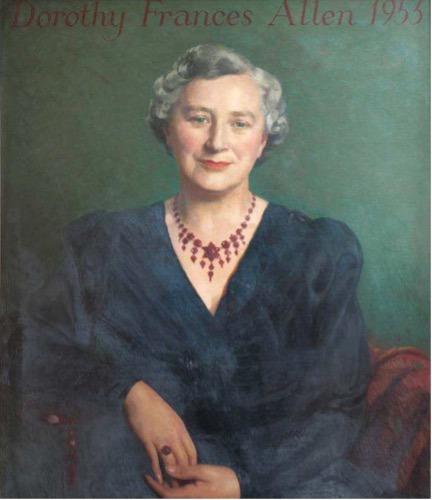
Portrait of Lady Dorothy Allen by Edward Irvine Halliday, 1953
Somewhat intimidated by the scale of the role, and with two young children, the Allens arrived at Rhodes House in September 1931 and would remain there until 1952. Dorothy describes the pre-war years through a succession of stories about social events for Rhodes Scholars, trouble with domestic servants and foreign travel. To a 21st Century audience, it reads a little like a series of Downton Abbey, with no shortage of drama and serious illness.
On one trip to the US, with both C. K. and US National Secretary Frank Aydelotte suffering from what might now be described as “man flu”, Dorothy was surprised to find that everyone expected her to deliver her husband’s speech at a Rhodes Dinner in New York, and even more surprised to find that he hadn’t actually written the speech. Writing and delivering the speech was, like so much of her time at Rhodes House, a baptism of fire which she navigated with eloquence and good humour.
This lifestyle changed dramatically in September 1939, with immediate preoccupations becoming the acquisition of 500 yards of blackout material for a mostly uncurtained Rhodes House, and the retrieval of dispersed Rhodes Scholars who had undertaken ill-advised distant summer trips. During the war, most Rhodes Scholars returned home, but Rhodes House was busier than ever, accommodating a dizzying array of evacuees and Canadian and American soldiers on leave who were staying in Oxford. Post-war years were equally hectic with Rhodes House being a social hub for the families of married Scholars.
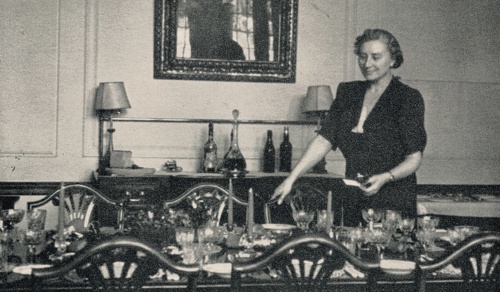
Christmas at Rhodes House, 1951. From Sunlight and Shadow.
The Allens left Rhodes House in 1952 and remained in Oxford until Dorothy’s death in 1959. The oration from her honorary degree ceremony concludes:
We remember her charming hospitality during the last twenty years, not only to the Rhodes Scholars in her care, but to many others also. We think of all she did during the war for members of the Forces on leave in Oxford, entertaining them with the help of the Muse of Dancing. But her greatest title to praise she earned some few years ago when Rhodes Scholars-elect were allowed to marry. Suddenly, in an Oxford already overcrowded, provision had to be made for more than eighty wives and about fifty children. Undismayed, she sought out accommodation for them ‘in any nook and cranny’. She generously gave up part of her own house to lodge them, and part to make a crèche where mothers took turns in minding their own and others’ children. She patiently initiated them into the use of coupons for buying food and clothes. A Gallic poet once wrote in praise of Rome: