Rethinking Fulbright: The Discipline of Power

Monday 16 March, 2026

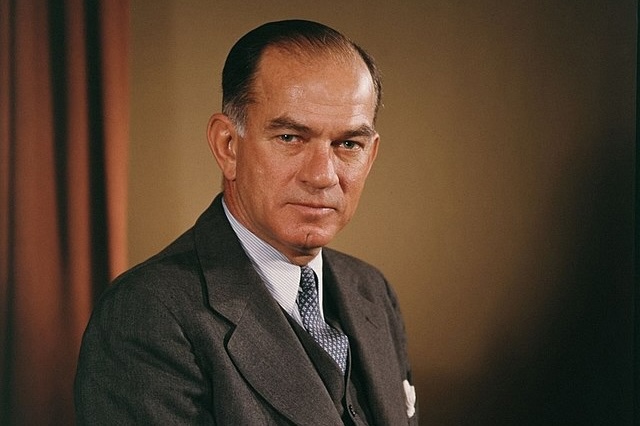
As part of our "100 Years On" series, Bincheng Mao (China & Exeter 2025) examines the legacy of J. William Fulbright (Arkansas & Pembroke 1925).

Best known now for the Fulbright Programme, he was the first Rhodes Scholar to become a US Senator but his political career contained contradictions - a multilateralist on international issues while opposing civil rights reforms domestically.

In Fayetteville, Arkansas, the name “Fulbright” is inescapable. It is home to the Fulbright College of Arts and Sciences, the largest school within the University of Arkansas. A statue of Fulbright stands in front of Old Main, the college’s main building, and there is also a fountain named after him. 

I experienced it firsthand when I went to Fayetteville in 2019, backpacking through the American South on a very tight budget, in an attempt to learn more about the country than I had learned from books. In every state I went to, I tried to visit the local university. I have come to see universities as a kind of mirror to society. They have taught me that America is not only defined by its geography but by its culture, its traditions, its discussions.

When I asked local residents in Fayetteville about J. William Fulbright, most offered only general descriptions: an important Arkansan, a former senator, and the namesake of a scholarship program. A few also mentioned that he, too, had been a Rhodes Scholar. It never occurred to me that I would step onto the campus of Oxford exactly a hundred years after Fulbright—he was a member of the Rhodes class of 1925, while I am a part of the class of 2025.

An entire century is enough to weather bronze and reduce a life to just a handful of labels. It is, nevertheless, not enough time to answer the questions on the hubris of power. To this day, we still need to speak of Fulbright precisely because the choices he made, between war and peace, between civil liberties and local control, and between process and populism, remain relevant to our decision-making process today.

A Theory of Force Built on Discipline

If I were to summarize Fulbright’s intellectual approach to the use of military force abroad, I would begin with a simple proposition: American power, in his view, had to be disciplined before it could be decisive. Before Fulbright became one of the most vocal opponents of the escalation of the Vietnam War, he came of age between the two world wars and witnessed Europe’s descent into destruction. Before entering elected politics, Fulbright, as the University of Arkansas’ president, called for the US to enter the war in 1940, remarking that “it is far better to fight for [our freedom] and to lose than meekly to acquiesce,” according to his biography by William Berman. Once in Washington, he helped push the US House to adopt what became the Fulbright Resolution to foster a postwar international order that supports international peacekeeping. That instinct matters because it clarifies what his later dissent was not: it was not rooted in isolationism or an unconditional aversion to the use of military force. It is a demand that force remain a tool of policy rather than a substitute for it.

In all honesty, this distinction appears much easier to praise in the abstract than to practice in public office, as the costs of saying “no” are immediate from the public and the costs of escalation are often deferred as the war unfolds. Vietnam exposed this situation. By the mid-1960s, the war had become a collision between America’s immense capacity to apply violence and its limited capacity to dictate political outcomes in a country whose internal legitimacy it did not command. Fulbright’s break with the escalation was therefore not primarily a sentimental plea for peace; it was an argument about statecraft: that military action cannot rescue an incoherent strategy, and that the illusion of control is among the most expensive habits of great powers.

He had reasons, at first, to follow the prevailing logic. In Washington, the Cold War’s categories were not merely intellectual. They were institutional. They shaped budgets and reputations alike. But Fulbright began to question what those categories were doing to the country's judgment—how the language of “credibility” could be stretched until it meant fighting a long war just to prove that one could fight long wars. He was right: the country was mistaking a test of will for a test of interest.

As Chair of the Senate Foreign Relations Committee, Fulbright turned his worry about the war into the institutional practice of oversight. The televised hearings he convened on Vietnam did something unusual. They made room for dissent inside the governing class. They, later known as the “Fulbright hearings,” brought the administration’s case into sustained daylight and invited serious critics—diplomats, legislators, and veterans, including John Kerry—to explain why escalation might deepen, rather than resolve, the problem. Kerry would later go on to hold the chairmanship of this committee during his Senate career. With the hearings, Fulbright treated oversight into strategic asset: a way to force a powerful executive to both give clarity about its war aims and consider the alternatives before sunk costs became a substitute for argument.

What made this political courage, in the most practical sense, was that his dissent targeted a president of his own party at the moment when disloyalty was often punished. It was especially risky since that president was Lyndon B. Johnson, who was known to intimidate those who refused to toe the party line. It’s always tempting in moments like these to turn opposition into little more than posturing — loud, uncompromising, and easy for those in power to brush aside. Fulbright’s critique was more threatening than that, because it was grounded in the vocabulary of responsibility—ends and means, legitimacy and consent. He was insisting that the United States could not purchase a stable political order abroad at any price it was willing to pay, and that the attempt to do so would erode the very foundations of American strength: trust in institutions, confidence in leadership, and the disciplined allocation of national resources.

His warning, at bottom, was about this theme: when a nation’s power grows faster than its strategic humility, it begins to treat resistance as irrational rather than informative. Fulbright understood that opponents—whether states, insurgencies, or populations—do not surrender simply because America is impatient. They adapt. They wait. They exploit the gap between what Washington says and what it can sustain. Restraint, therefore, is not retreat. It is the choice to preserve freedom of action by refusing missions that cannot be completed on reasonable and acceptable terms.

This lesson is relevant to those who grasp the fact that power is meant to be sustained, not squandered. Fulbright’s opposition to the excess of the Vietnam War was based on his conviction that military force is only legitimate and effective when it is accompanied by a constitutional process, as well as an appreciation for the limits of military power. He was an advocate for mature statesmanship, and we should remember him for that.

Refusing the Fever: A Lone Vote Against McCarthyism

A decade earlier, Fulbright faced a different kind of national emergency—one that did not arrive by troopship or missile test, but through a slow corrosion of confidence. McCarthyism was, in part, a response to genuine fears: Soviet espionage, the Kuomintang’s defeat in China by communist forces, the Korean War, the unsettling sense that history had accelerated and America might not be steering it. But the movement that gathered around Senator Joseph McCarthy did not simply hunt for subversion; it trained citizens to see accusation as proof and skepticism as complicity. In that climate, courage looked like defiance in a single vote that refuses to let the Senate fund its own panic.

In 1954, Fulbright cast a solitary vote against appropriating money for McCarthy’s investigative committee. That fact can sound quaint today—one senator, one line in the record—but the setting matters. The Senate is built to distribute risk: to make individual dissent unnecessary by encouraging collective anonymity. To be the sole vote is to accept the full weight of isolation. It is to say, in effect, that you do not merely disagree with the methods—you deny them legitimacy and refuse to subsidize them.

The deeper point is that Fulbright’s opposition was not only a defense of individual rights and liberties, though it was certainly that. It was also a judgment about national capability. A country that permits its institutions to run on suspicion as opposed to evidence becomes strategically clumsy. It teaches officials to prioritize survival over candor. It drives talent out of government. It turns complex foreign realities into moral melodramas. It encourages the kind of conformist thinking that produces avoidable disasters—because when the cost of being wrong is merely embarrassment, people can admit error; when the cost is accusation and show trials, they cling to error with both hands. McCarthyism also offered America’s adversaries a real gift: proof that a democracy can turn on its own people—setting aside due process, shrinking its imagination, and undermining its own legitimacy. In a global contest that was as much about values as arsenals, that mattered. A democracy that cannot tolerate internal disagreement will struggle to persuade other countries that it is worth emulating.

Fulbright’s role in pushing the Senate toward condemning McCarthy fits this same logic. The point was not to win a moral argument at a dinner party; it was to restore an institution’s self-respect. Legislatures cannot compete with individual demagogues on spectacle. Their comparative advantage is process: hearings that test evidence, rules that slow hysteria, votes that force accountability. For Fulbright, the Senate wasn’t a place for careers and speeches. He saw it as a check on the politicians' worst instincts.

Once again, his bravery was grounded in realism. He wasn’t staking his career on the utopian assumption that fear would be eliminated. He was arguing that fear had to be managed. And so, this vote too has to be read at the grand strategic level: it was an early recognition that internal disciplines, constitutionalism, fairness, and integrity are not separate from power but are part of what makes it workable.

Civil Rights and the Flaws of the “Great Man” Story

There are often traces of the “great man” theory at work when we discuss major political moments in history—leaders who “saw further,” acted earlier, and bent events to their will to save everyone from the brink. That framing carries a quiet hazard: it trains us to look for greatness where we should be looking for those who are marginalized and those who bore the costs of those supposedly great men’s actions. On the issue of civil rights, J. William Fulbright is a case study in why the “great man” story can mislead. His record shows how easily a true intellect can accommodate injustice when it is domestically convenient, culturally normalized, and politically rewarded.

To see what was at stake, it helps to recall the constitutional and social terrain of the 1950s South. In 1954, Brown v. Board of Education declared that segregation in public education was inherently unequal, rejecting the legal premise that separate facilities could be equal. The following year, the Court’s remedy in Brown II urged racial desegregation with “all deliberate speed”—language chosen by Chief Justice Warren to manage implementation but often exploited to postpone it. The political response in much of the South was not to concede the moral claim, but to dispute the institutional authority: to argue that the Court had overreached, that local order was under threat, and that resistance could be justified as a defense of constitutional balance.

The Southern Manifesto of 1956 was the clearest expression of that response. It framed the Court’s decision as a “clear abuse of judicial power” and called for resistance through “lawful means”—legislation, litigation, and procedural obstruction—while presenting that resistance as a principled stand for federalism and constitutional restraint. Fulbright signed it. In later years he also opposed the Voting Rights Act in 1965 and voted against major civil rights legislation, aligning himself, repeatedly, with the machinery of delay.

If we treat Fulbright as a “great man,” the temptation is to interpret these choices as strategic positioning in service of a larger good—an unpleasant compromise to preserve influence for more important battles, particularly in foreign policy. There is a grain of realism in that narrative: national leaders do operate within constraints, and moral clarity does not always win elections. But realism becomes evasive when it is used to excuse predictable harm. In civil rights, the costs of “waiting” were not abstract. They were borne by Black citizens barred from full participation—kept from equal schools, denied access to the ballot, excluded from fair employment, and reminded through law and custom that their citizenship was conditional.

There is also a second temptation: to explain Fulbright’s record as merely the residue of his era, as though time itself were the author. But the era contained choices. The Supreme Court chose to confront segregation. Grassroots leaders chose to risk livelihoods, safety, and lives. Presidents chose, unevenly and imperfectly, to move federal power toward enforcement. Senators chose whether to reinforce those shifts or obstruct them. Fulbright’s signature on the manifesto and his votes against civil rights measures were not accidents of atmosphere; they were actions that lent prestige and legislative weight to a structure designed to outlast the moral pressure of the moment.
And yet the story does not remain static—which is precisely why the “great man” frame is insufficient. Fulbright’s later votes show movement, though such a shift came too late to redeem his earlier failures on civil rights. In 1967, he voted to confirm Thurgood Marshall, who argued for the plaintiffs in Brown v. Board of Education, as the first African American justice at the US Supreme Court. In 1970, he voted against the nomination of G. Harrold Carswell, who had previously advocated for white supremacy during his unsuccessful Georgia legislative bid in 1948—rejecting the view that such history could be separated from judicial fitness. That same year, he voted for a five-year extension of the Voting Rights Act that he originally voted against, supporting the continuation of special provisions aimed at outlawing discriminatory voting practices, especially in the South. In 1972, he voted to strengthen the enforcement powers of the Equal Employment Opportunity Commission, backing stronger federal power to combat discrimination facing African Americans in the workplace.

It is perhaps possible to read these votes as signs of personal growth—of a politician adjusting to a changing moral and political landscape, or finally recognizing that a durable republic requires equal citizenship in practice, not only in theory. It is also possible to read them more narrowly as adaptation: an elite senator tracking the direction of national consensus once the old order had become harder to defend. The record supports both interpretations, and that ambiguity is part of the point. When change comes this late, it is often indistinguishable from inevitability—and leaders who once resisted can later appear to have “come around” without reckoning with the damage of their earlier resistance.

That is where the “great man” story most distorts. It suggests that progress is something granted by enlightened figures when they are ready, rather than something extracted by citizens who refuse to accept the terms of delay. It invites us to locate moral momentum in Senate votes rather than in the lives that forced those votes onto the agenda. Under that lens, Fulbright’s civil rights record should not be romanticized as a redemptive arc. It should be treated as a warning about how intelligence can coexist with moral blindness, and how a sophisticated theory of constitutional restraint can be selectively deployed to preserve local injustice.

There is, however, a way to be critical, without being reductive. Fulbright’s failures on civil rights do not require us to dismiss his insistence on legislative process, institutional legitimacy, and constitutional limits. Those principles matter. But the civil rights era exposed how those principles can be misused—how “process” can become a shelter for inertia, how local control may sometimes become a euphemism for exclusion, how “restraint” can be invoked to restrain only the federal government while leaving unrestrained the coercion of state and private power over a disenfranchised minority.

In a republic, rights are not truly rights if their protection depends on local permission. The strategic consequence of that truth is not only domestic; it is international. A country that presents itself as the guardian of liberty cannot credibly do so while defending a racial caste system at home. Segregation was both a complete and utter moral failure and a self-inflicted wound to the legitimacy on the world stage. On that central question, Fulbright was too often on the wrong side at the time it mattered most.

So if Fulbright remains worth studying, it is not because his life offers an uncomplicated model of leadership. It is because it refuses to cooperate with our desire for tidy heroes. His civil rights record demonstrates that political courage is not a general trait that, once possessed, applies everywhere. It is situational, selective, and frequently constrained by what a leader is willing to risk—status, relationships, reelection, belonging. The “great man” story encourages us to look for towering consistency. Fulbright’s record instead insists on a more demanding task: to judge leaders not only by the sophistication of their arguments abroad, but by whether they are willing to pay a price for equal citizenship at home.

Reconsidering Fulbright

Fulbright’s life resists easy moral accounting because it unfolded within constant tensions. He was not a romantic dissenter, nor a reflexive partisan. He was a legislator who believed that American strength depended on discipline—on the alignment of means with ends, and on institutions capable of absorbing fear without surrendering to it. That belief explains his most admirable stands: questioning escalation in Vietnam when it no longer served a coherent strategic objective, and resisting McCarthyism when it threatened to convert fear into governing principle. In both cases, his argument was not about retreat. It was about strategic stewardship—about conserving national power by refusing to confuse activity with strategy or accusation with evidence.

At the same time, his civil rights record also reveals the limitations of this stewardship. He also signed the Southern Manifesto and opposed landmark civil rights legislation such as the Voting Rights Act. These choices allied him with a regional status quo that did not support equal citizenship. We should not overlook these choices as merely a function of their time. These choices were judgments, and they had real effects on human beings’ lives.

Democracies can only survive when leaders recognize that power must be responsible to principles. Those principles need to be applied consistently, even when it is politically difficult. Fulbright met that test only unevenly. The responsibility to meet it more fully belongs to those who follow.