
Vandana Ramrakha-Jones (Kenya & Somerville 1994) is the only paediatric dermatologist in Cornwall, single-handedly running the service at Royal Cornwall Hospital covering a population of more than half a million.
How did you end up in Cornwall?
I was a Rhodes Scholar towards the end of my medical training at Oxford and then went on to do various junior doctor jobs in the UK. I met my husband at university in Oxford and when we got married, we were up in Scotland. But my family being in Kenya and his being in Somerset, it was a sort of practical decision - we would love to be nearer family but we were desperate to keep our careers as active as possible. He was ophthalmology, and I was dermatology - I didn't want to stop work, he didn't want to stop work, but we definitely wanted to be together. That wasn't a given - with all our friends, quite often if they wanted to be together, one had to compromise, or they had to move somewhere where one had a job but the other didn't. My husband was ready to apply first and he looked around but was unable to secure a job in Somerset, but one came up in Cornwall. So we came and had a look around and decided that's where we wanted to be.
When I asked the dermatology unit whether they needed a doctor, they said, "Yes, yes, we do… and do you, by any chance, do children? Because nobody else in our unit is interested in the paediatric side." And because I'd done some work at Great Ormond Street and at what was then Yorkhill Children's Hospital in Glasgow, I was really keen to carry that on. So it just seemed like it was meant to be.
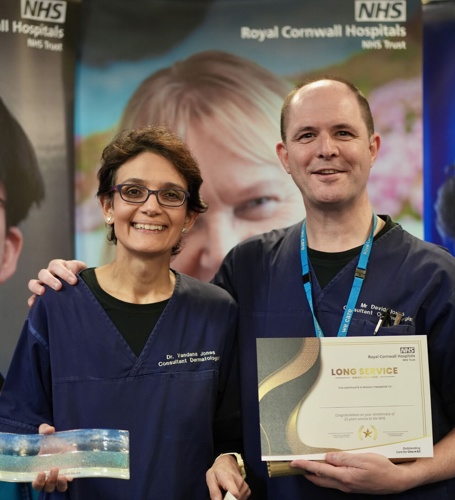
Tell us about your work
It’s quite a unique demographic for being a dermatologist - the skin cancer rate in Cornwall matches that of Australia because of the outdoor work, outdoor hobbies, the location near beaches. So I ended up doing a mix of adult and children. On the adult side, I found there was there was so much work with skin cancer prevention and treatment, but nobody else was doing the children, so I started to build that up.
What I didn't realize was what a kind of geographical island Cornwall is to the rest of the UK. The population is about half a million, it's very rural, and there's only one hospital. The population also doubles every summer when we have an influx of visitors. We realized that it was impossible to recruit more consultants to our unit because of this geographical isolation; doctors who come to visit look at the six-hour journey to London, or the lack of flights to their home country, and withdraw their application. In that sense, working in Cornwall has mainly similarities to working in Africa.
Having started here 18 years ago, we haven't managed to recruit another paediatric dermatologist. So my expertise has grown, and also my passion for providing the best that I can for any child that comes in front of me, because I realize that it's only me. Nowadays, those who can afford it might try and go privately, but the only private hospital in Cornwall doesn't take children. If you're a parent of a suffering child, you have to go outwith the county if you want to seek any other help.
The priorities of the Trust have historically been cancer work, as you can imagine; when our staffing crisis was at its worst, skin cancer clinics were put in in preference over inflammatory skin clinics. But children who are suffering, who aren't sleeping, who have terrible eczema – they are just as needy. So I've just tried to make my working week such that I'm at the beck and call of the children and their parents as much as I possibly can be. Having had such privileged training and experience, I really want to give back as much as I can.
I am aware that I'm not going to last forever, so we are really trying to push the “grow your own consultants”, GPs who are interested, and other trainees who are interested in children. My big focus in the next year is going to be teaching and training.
There is a lot of discussion at the moment about how crucial immigrant doctors and nurses are to the NHS.
I'm all for immigrant workers in the NHS, and besides which, Cornwall needs to diversify a lot more. It's been amazingly healthy for our hospital department to have visiting doctors and nurses. Some of the most dedicated people are from abroad - they've seen so much pain and suffering through lack of healthcare in their own country that, anything they can give back, they will. I think that's been my ethos, but I've seen it in many colleagues. For example, we have colleagues from the Philippines in Cornwall at the moment, and they just work extra hard. The health service would collapse without them.
Every time I go back home to Kenya, I see what it's like to not have money to pay for medicines. You're inviting people to see a different way for their skills and their talents to make a real difference.
Did you ever consider going back to Kenya to work?
Early on I wanted to spend a year in Tanzania where they have a dermatology unit specializing in TB, leprosy and HIV - all conditions that I was interested in. But then life and family and choices meant that didn’t happen. My family are still there; they are all in healthcare, so I go back once or twice a year. My husband is English, but his grandmother was born in Uganda, and his parents lived in Kenya and Zambia for a while with the Flying Doctors Service. We have lots of African roots, and it never leaves you.
If you could make one improvement in the NHS, what would it be?
More educators for primary care, for nurses, for patient health, more ways to teach and train. In this day and age, that can be podcasts or videos - it doesn't have to be me showing somebody one on one how to apply the treatments correctly for their child's skin. That would be my priority.