I Am Not A Cyclist

Tuesday 07 April, 2026

by Laura Wegner (Germany & Keble 2025)

So I Cycled 1,500 km Through the Entire UK

The most cycling I had ever done in my life was five minutes to school and five minutes back, with the occasional family bike tour in the German countryside in the summer. 

So naturally, the summer after graduating from Harvard and before starting my Rhodes journey at Oxford, I decided to cycle the entire length of the United Kingdom. Land's End to John o' Groats. 1,500 kilometres. Alone. With a bike I got when I was 12, a toolbox I had just taught myself to use, and no accommodation booked beyond the first night.

The Motivation

I used to be a competitive swimmer, until a knee injury ended my competitive career and left a gap I didn't quite know how to fill.

What I was missing was a particular feeling. In the final metres of a race, when everything hurt, when I felt like I had exhausted all my energy resources and didn't think I could keep going, when my legs and arms were burning, I pulled out the last bit of energy and gave it my all. Then I hit my hand against the wall, looked up at the electronic board that told me how fast I had gone, whether I had reached my goal, whether I had won the race, and I felt this extreme sense of accomplishment. It was an absolutely amazing feeling that you only get when you have mentally and physically given something your all. I had never felt it again with any other sport or any other kind of accomplishment.

In the summer of 2025, I wanted to rediscover it. I wanted to traverse an entire country, and biking made the most sense: faster than walking, but more exciting than faster modes of transportation. The choice of country was relatively simple. Even though I grew up in Germany, I had never explored the UK, and it felt like the perfect opportunity to get to know a place before moving there. I decided to cycle its entire length. This turned out to be a known challenge called Land's End to John o' Groats, or LEJOG.

Making It Meaningful

I also wanted the ride to mean something beyond my own personal quest.

Since 2022, I had been working on a problem that started as a personal frustration. So many doctors had parts of my medical history, but they were never all together in one place, and most importantly never all with me, the patient. When I started college, I had every intention of becoming a human rights lawyer, but this problem bothered me so much that I redirected my path entirely into healthcare technology. I had no medical background, just this one problem that I could not let go of. I have worked on it for more than three years now and also started doing research on precision medicine, looking at what you can predict when you have a patient's entire medical history to personalise their treatments. So many avoidable medical errors happen because physicians do not have patients' complete medical history for informed decision-making. My bike tour felt like the right moment to take action beyond my own research, so I decided to fundraise for AvMA, Action against Medical Accidents, a UK charity working to prevent avoidable medical harm and support the patients affected by it.

Watch Laura talk about her work for her MSc Social Data Science at the Oxford Internet Institute, applying her computer science background to healthcare, and hear more about Action against Medical Accidents, the charity Laura supported.

The Challenge Before The Challenge

In March 2025, I wrote "cycle through an entire country this summer" in my Notes app. I then did absolutely nothing about it until I got home from the US at the end of June. Mid-July, I decided this was actually happening and started researching what I needed. I needed three main things: a route, a way to get my bike to the UK, and enough mechanical knowledge to fix my bike if something broke in the middle of nowhere. In terms of actual training, I did not do much other than one 20km ride, one 30km ride, and two 40km rides in the countryside around my hometown. 

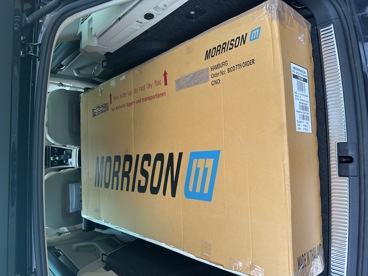
Getting my bike to the UK was its own adventure. I discovered that I could put my bike on a Ryanair flight, which meant avoiding a complicated, multi-day train journey. What I did not realise at the time was that this meant fully disassembling and packaging it. I had never disassembled a bike before. I watched YouTube videos and relied on trial and error. Two days before the flight I went around asking local shops if they had spare boxes in my bike's dimensions. I found one, brought it home, and discovered it absolutely did not fit in my parents' car. I disassembled the bike further, found a smaller box, and eventually fit everything in.

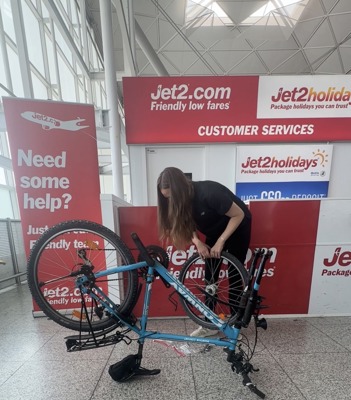
The travel day itself was smooth. I flew from Bremen to London Stansted, walked to baggage claim, and spent forty minutes on the airport floor reassembling my bike screw by screw.

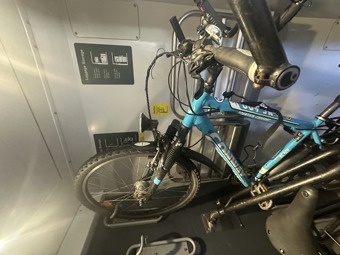
Then I took the train to Liverpool Street, the underground to Paddington, and another train to Penzance, the southernmost railway station in the UK, though still 15km away from Land's End. On the train, I had to hang up my bike in a storage area, which would have been impossible to do without the help of very kind strangers.

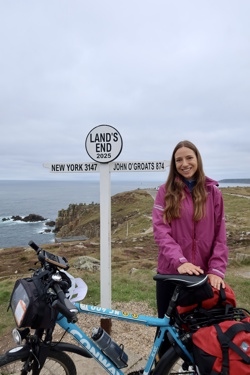
I arrived in Penzance, cycled to my hostel, and went immediately to sleep. The next morning I took a taxi to Land's End, and I began my journey.

The Route

  • Day 1: Land's End to Truro 
  • Day 2: Truro to Exeter 
  • Day 3: Exeter to Bristol 
  • Day 4: Bristol to Worcester 
  • Day 5: Worcester to Birmingham 
  • Day 6: Birmingham to Liverpool 
  • Day 7: Liverpool to Manchester 
  • Day 8: Manchester to Lancaster 
  • Day 9: Lancaster to Carlisle 
  • Day 10: Carlisle to Edinburgh 
  • Day 11: Edinburgh to Perth 
  • Day 12: Perth to Grantown-on-Spey 
  • Day 13: Grantown-on-Spey to Tain 
  • Day 14: Tain to Thurso 
  • Day 15: Thurso to John o' Groats

Three Types of Days

Every day of the journey fell into one of three categories. Brutally hard. Terrifying. Or breathtakingly beautiful.

The first day was immediately way harder than I thought, but also way more beautiful. I filmed on my Ray-Ban Meta glasses as I cycled along the coastline, past the ocean and the wildflowers. It was hill after hill from the very start. There was one particular hill that made me feel like my heart was going to jump out of my chest.

Then my powerbank stopped working. I had been charging my phone all day for maps and filming, and at some point realised the battery was at 10% and the powerbank, despite being plugged in, was no longer charging it. I closed every app, tried to mentally retrace my route, and cycled back to the nearest town to find a replacement.

I very much loved this first adventure. Nothing had gone entirely to plan, but I now understood what I had in front of me, and I was looking forward to every bit of it.
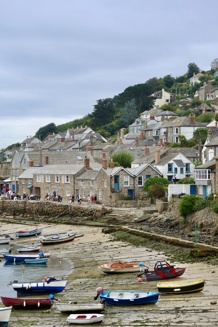
The second day was approximately 90% terrifying.

The route immediately started on a very busy road, uphill, for about four hours, with no bike path. Just me, my bike, and cars flying past me. The hill was so steep that I was moving slowly, which made me unsteady. At the steepest points I had to get off and walk, which was somehow even worse because I was now a pedestrian on a road that was very much not built for pedestrians.

In my head, I was desperately wishing for quieter roads. No cars. Some peace.

Unfortunately, I got exactly what I wished for. My navigation app, Komoot, sent me into the emptiest landscape I had ever seen. No humans, no houses, no actual roads. Just fields and fields and silence, which turned out to be more terrifying than the busy road.

At one point I found myself in what seemed like someone's backyard. I opened a gate. I ended up in a cow field. I sprinted to the other end, emerged onto a path, and realised it was one I could have taken from the beginning. Komoot had decided sending me through the cow field would save three minutes.

In retrospect: quite funny. In the moment: not funny at all. My heart had suffered quite a lot that day.
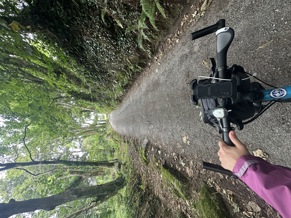
The third day was everything and more. Beautiful weather, flat paved paths, other people out on walks and in good moods. I cycled by the beach and passed Budleigh Salterton Beach, where boats sat in the water, people were swimming and lying on the sand, and cliffs rose up behind the shoreline.

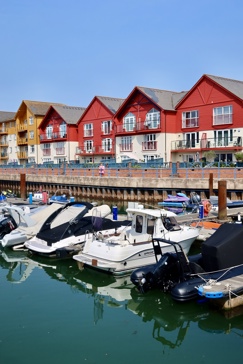
I also cycled past rows of colourful houses that I had only ever associated with Copenhagen, the kind that feature in every article about Europe's most charming destinations. In Cornwall they were just normal houses on a normal street. Nobody was making any fuss about them. I thought: this is the most underrated travel destination I have ever been to.

Everything In Between

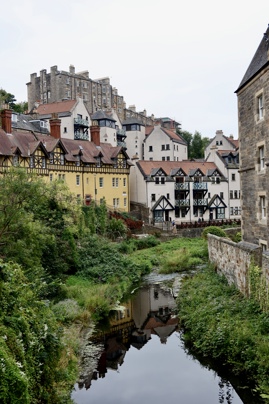
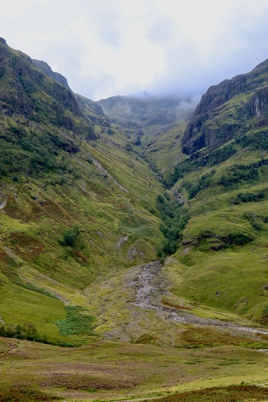
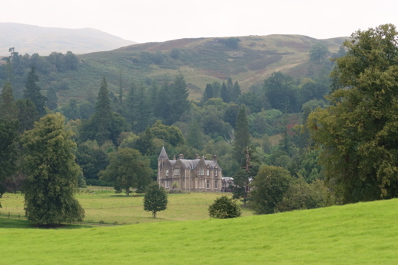
All the days that followed were a mix of Days 1, 2, and 3, with Scotland standing out as my absolute favourite part of the trip and one of the most beautiful landscapes I have ever seen in my life. It was somewhere in Scotland, looking out at a view that was genuinely breathtaking, that I realised I was really enjoying this solo challenge, but that seeing something so beautiful made me want to share it with someone. After all, life is meant to be shared. It also made me realise that the UK is far more than I had ever imagined. Some of the most extraordinary scenery people travel across the world to see is right here, and the most underrated destinations so often hold the most unforgettable experiences.

Not everything about the journey was quite so poetic. Food was a constant challenge. I could not refrigerate anything and most things came in multipacks too large to carry, so for two weeks, plain rice cakes and an apple were my breakfast and lunch every single day. I have not eaten a rice cake since returning home. I may never eat one again (unless they are chocolate covered).

I also cycled every day without music, imagining I would spend the hours in deep reflection, getting to know my own thoughts. What actually happened is that I was extremely busy. I was constantly turning left, right, going back, taking the wrong path. I could never have imagined that doing one single activity all day could keep a person so occupied.

Three Things I Learned That Have Nothing to Do With Cycling

Stress has a price tag

On Day 6, I had to catch the last ferry across the Mersey to Liverpool. I had planned to arrive an hour early. What I completely underestimated was the headwind along the water, which pushed me back with every pedal stroke, and the sandy paths along the beach, which slowed me down more than I expected. I watched my estimated arrival time tick later and later: three extra minutes, then six, then ten, then twenty, then thirty. I cycled with everything I had and arrived three minutes before boarding.

That evening, for the first time on the entire trip, I did not want to continue. The difference was not the effort. I had been working hard every single day. But that day I had been stressed, and stress had emptied me in a way that no amount of physical effort ever had. I learned that while hard work is usually fulfilling, stress just drains you. The best work, the work that makes you proud and keeps you going, is done with focus and positive motivation, not with one eye on the clock and your heart jumping out of your chest.

Go far, not fast

I used to go on runs and closely monitor my pace. I would cut runs short if it meant I could feel proud of the number. I was optimising for speed, which meant shorter distances and slower overall progress.


Cycling 1,500km cured me of this. Speed stopped mattering. What mattered was that I arrived before it got dark. After coming home, I stopped checking my pace when I ran and only looked at the distance. I started going farther every single day, and I realised this applied to far more than just running. The world usually rewards speed and early milestones, but most things that actually matter reward endurance and high-quality outcomes. You usually do not have to be the fastest, but you do have to keep going.

Look back

Every time I reached the top of a hill, I stopped and looked back before looking ahead. Some of the best views of the entire trip came in those moments. The valley I had climbed out of. The coastline receding behind me. The distance between me and where I had started. We spend so much energy oriented forward that we miss the view we have already earned. I am very dedicated now to adjusting my thinking to look back too.

The Finish Line

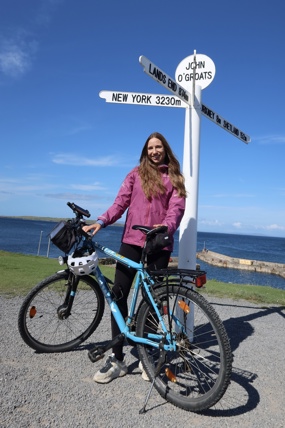
I arrived at the John o'Groats sign having cycled 1,500 kilometres, raised money for patient safety, and eaten more rice cakes than any human should. I stood there and felt exactly the feeling I had been looking for since the day I stopped swimming. Fifteen days, alone, through an entire country I had never explored. It was exactly as hard as it sounds, and it was absolutely worth every kilometre.

The funny thing about completing a 1,500km bike tour is that people assume it made me a cyclist. It did not. I dropped my bike off at Keble when I arrived in Oxford in August and did not touch it again until February, at which point I used it to cycle seven minutes to a football game and seven minutes back. Some things do not change.

What did change was everything else. The way I think about effort and stress. The way I run. The way I look back at what I have already done instead of only forward at what is next. I came home from John o'Groats with the feeling I had been looking for, three lessons I did not expect, and a very strong opinion about rice cakes.

I am already planning the next challenge, and if anyone has one in mind, I would love to join.

If you have ever felt that particular feeling, from a race, from something you built, from any moment where you gave everything and came out the other side, go find it again. It looks different for everyone, but the process of finding your version of it and actually doing it is one of the most important things you can do. I really believe that.

You do not have to be a cyclist. I am not one either.