
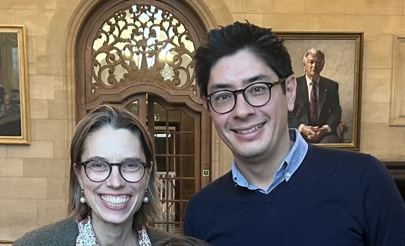
On a recent visit to Rhodes House, Harriet Gee (Australia-at-Large & Magdalen 2006) and Eric Knight (Australia-at-Large & Magdalen 2007) talked about their work at Sydney and Macquarie Universities, balancing their careers with their responsibilities as parents of three young children, and Eric's new role as the Rhodes Trust's State Secretary for New South Wales.
Tell us about your work
Eric: I am a Professor of organisational theory at Macquarie University, and I also serve as the Deputy Vice-Chancellor of People and Operations for the university. I was previously working at the University of Sydney, and I moved in 2020 to Macquarie University.
Harriet: I'm an Associate Professor in Medicine at the University of Sydney. I'm a clinician, a practising radiation oncologist, and I specialise in lung cancer. I help to run a program of research looking at how radiotherapy can be improved. It's a very rapidly changing space internationally, with lots of changes afoot both in terms of technology and funding.
Eric: Harriet's at an interesting nexus between physics and biology, and also between pure research and clinical application, in a very populous part of Sydney but with mixed demographics.
Harriet: My hospital and Eric's university have a very similar catchment area. Where I work in Western Sydney, it's incredibly diverse. It's one of the most diverse places in Australia, something like 52 different nationalities, with no real single dominant nationality. Lots of different languages, lots of different experiences — many people have recently migrated or have lived in Australia for a little bit longer. But they very much have that migrant experience.
Eric: When you think about what it is that makes Australia distinctive as a place of work and research, it is partly because we have a universal healthcare system. And therefore, when you bring the universal healthcare system to bear on such a diverse migrant population as you have in Sydney, you're able to trial new drugs more quickly, do new clinical trials, and learn about populations in new ways.
Eric, you've moved into more of a leadership role at the university – what attracted you to that?
Eric: I think that at its heart lies a deep interest in the role and power of education to transform people's lives. When I left as a Rhodes Scholar, I worked in business for a little while but kept having that pull back into academia, and so returned three or four years after my doctorate into an academic position.
Doing my research and teaching was amazing, but the ability to deepen and broaden the impact on lives and communities through commercialising technologies and transforming curriculum naturally moved me towards trying to make an additional contribution. I still do research and have a light teaching load.
Often people think of university leadership as administration. But the leadership of a university needs to embody the values of the university. The decisions of how you allocate resources, scarce as they are, are really values decisions. And I think universities play a critical role in the social infrastructure of liberal democracies in particular — to inspire staff and students alike to be curious, to debate difficult ideas, and, by wrestling with complexity, to learn and discover new things. That's hard work, but it's what pulled me from my own research to service to the institution. For a time I led the research and research commercialisation at the University of Sydney as Pro-Vice-Chancellor (Research – Enterprise & Engagement). Then I became Executive Dean of Macquarie Business School. And now I lead the broad operations of the university, where I’m focused on student recruitment and student and staff service delivery, workforce planning and HR, and digital investment and transformation for the university overall.
Universities around the world have perpetual funding challenges, with the humanities in particular under threat. How has that affected your institutions?
Eric: We've had a difficult few years at Macquarie University for various reasons. One of the things that I've come to appreciate is that people think these are challenges for the university – and at one level they are. But at another level they are a challenge for society. How do we inspire students to want to learn these things? Because you can't run courses in history, or for that matter Latin and ancient Greek, if there aren't any students turning up and enrolling in the subjects. And I think that's the great challenge — a university that runs courses but doesn't have students turn up is not financially sustainable. And so I think the challenge we all face is how do we make the humanities interesting? Why is it important for us to understand history? How does it solve the contemporary issues of today? Those are the real questions that sit behind course changes and course cuts.
Harriet: The Australian funding agencies are very big on translational research at the moment — that's research where you are very close to the clinic in what you're doing. You are using patient samples to answer questions. One of the things that I have found most helpful in my research — what has led to the biggest breakthroughs for us — is actually stepping further back from the clinic. We're trying to answer a clinical question, but we are going deeper into the fundamental biology. We're stepping back into more molecular, more basic science. You can call it blue-sky research — that research where you don't quite know where it's going to lead but which is really fundamental to the way we understand how the world works.
I see patients every day. We know that for some reason radiotherapy works really well for some people [and] it doesn't work for others. So then the question is "why?" And what I've found is [that] the answers to those questions tend to be quite surprising. And it was because we went back into the lab and used these very fancy microscopes to try to answer these questions.
So there is this tension at the moment between governments thinking translational research is a great idea, and experts and mentors saying, "Don't rush to get into the clinic; stay in the lab, keep doing more work in the lab, and really sort out those questions."
That type of research can be very difficult to fund, but I think as a Rhodes Scholar, hopefully you can advocate for that very basic scientific research.
Several Rhodes Scholars working in education have told us about changes to US government education policy having an impact well beyond the US. Has this impacted your work?
Eric: Research is a global activity: labs are connected internationally, grants are connected internationally. So the extent to which it has played through for us is that by imposing onto US research teams requirements for their national interests, this flows through the funding chain to their research partners. It's impossible to draw geographic boundaries between research teams — academics think more about their discipline than they do about their postcodes.
Harriet: Many of the people who we supervise to do Masters and PhDs won't become pure lab scientists. They may be doctors going out into clinics. I see a big part of our role as an educative one, so that if you're a doctor out there in the community, you can better advocate for your patients because you have that scientific language. What I have noticed when I'm speaking with my US colleagues is the impact that these changes have on their graduate programs. Although it doesn't affect us directly, that pipeline of people who are educated in the scientific language will likely be affected.
You both have demanding careers – how do you balance those with the responsibilities of having a young family?
Harriet: Well, it's a process of negotiation — there's not a rule book.
Eric: There was a book recently on Rhodes Connect about something like "plant parenting". I thought it was a really great phrase — the idea that you can't control the plant, but you can create the nurturing environment in which the plants can grow. We can't really control these kids, but we try and create a safe environment [where] they can discover themselves. I found that to be a very rich metaphor for trying to create the conditions for a happy, healthy family.
Harriet: And I think that being a Rhodes Scholar, when you're in Oxford, you have that unique time in your life to really think about your values and to be quite explicit about what values you think are important. And when you go out and do the messy business of actually living life, you don't necessarily have time to think about those, but you've got those values laid down. That's the intention we bring to our parenting day to day, with more or less success. You just try to be guided by those values.
Eric, you've just taken on a new role in the Trust
Eric: I will take on the Secretary role for New South Wales in Australia. I have a lot to learn in that regard, but I've been very mindful [in] coming into this role about how we can make the Rhodes Scholarship attractive and accessible to people who have never met a Rhodes Scholar before or don't really know what it involves to apply.
And my thought on that is that we need to turn to human stories — Rhodes Scholars past and present — to share their journey, how they became curious about the Rhodes Scholarship, what the application process was like for them, and what, having come to Oxford, they now know and wish they could share with their past selves.
It's an enormous privilege to be a Rhodes Scholar. I think all of those who have taken on the Scholarship need to accept and own that privilege, and use it to make it available to others as widely as possible.