
History has a funny way of repeating itself. In 1925, a young man from Ulverstone, schooled at Sacred Heart and the son of a builder, set sail for Oxford as Tasmania's Rhodes Scholar. His name was Roland Wilson. One hundred years later, in 2025, having also grown up in Ulverstone, attended Sacred Heart, and been the son of a builder, I flew to Oxford as Tasmania's Rhodes Scholar. I may be the second Rhodes Scholar from Ulverstone, but this is a call-out for the next. No matter where you're from, this life-changing opportunity is for you.
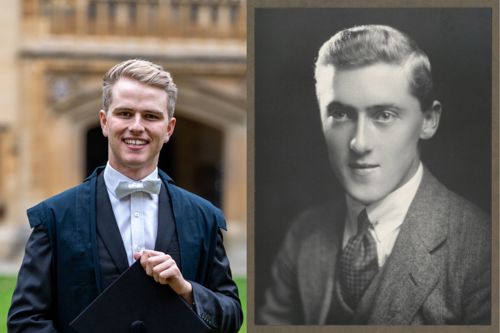
The world looked a little different when Roland made that voyage, yet many of the events that punctuated his life feel eerily familiar. Australia was in its "confident years": radio broadcasts were just beginning, cars facilitated growing suburbs, and both the Sydney Harbour Bridge and Parliament House were taking shape.
When Roland arrived at Oxford, they did not recognise his commerce degree from the University of Tasmania. As a result, he first completed a diploma in economics and political science. An early essay on social and economic experiments won him the prestigious Beit Prize in Colonial History, along with permission to enrol in a Doctor of Philosophy. He completed a doctorate at Oxford, then another in Chicago, both examining how a country's economy is affected by borrowing from overseas.
What followed was a career that helped steer Australia through some of its most defining decades. He served as Commonwealth Statistician, then as Secretary of the Department of Labour and National Service, overseeing post-Second World War reconstruction planning, before becoming Australia's longest-serving Treasury Secretary. After nearly sixteen years shaping the nation's post-war economic architecture, he stepped down and went on to chair both Qantas and the Commonwealth Bank.
Sir Roland Wilson's impact on modern Australia cannot be overstated. It is little wonder he earned a reputation as the most powerful public servant in the country. Beyond a few coincidences and a shared academic interest in economics, I won't pretend my path looks much like Sir Roland's, or that I expect to leave anything like the same mark. What I keep coming back to are the parallels between his world and ours.
He left in 1925, with the post-war order newly rebuilt and a cautious optimism in the air. Yet the ground beneath it was unstable. A depression, and then another war, lay on the horizon. The great question of his era was how to build stable, resilient economies in a world that would not hold still.