
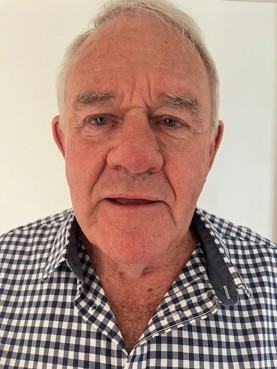
Photo of Tony Saner.
St Andrew's College, Grahamstown & Pembroke 1973
Born in Johannesburg in 1949, Tony Saner studied at the University of Pretoria and went on to Oxford to do research in cardiac physiology. He returned to South Africa to study medicine and undertook GP training in England before practising as a GP in South Africa for over 35 years. This narrative is excerpted from an interview with the Rhodes Trust on 27 October 2025.
‘I was just really privileged’
I was born in a maternity hospital in Johannesburg that was run by nuns. It’s still in existence, and when I was in practice, I ended up looking after the nuns and their order, so it’s almost as if the wheel had gone full circle. I now live about a kilometre and a half from where I grew up in Parkview, Johannesburg. These days, it’s considered a nice, old suburb, but it was really a mining town, with houses put up as cheaply as possible. My father was a lawyer and ran his own business in town.
In terms of schooling, I was just really privileged. I went to a little government school in Parkview and then on to The Ridge School, which was a private school started by a Rhodes Scholar called Guy Nicolson (St Andrew’s College, Grahamstown & Trinity 1914). He had been to St Andrew’s College, Grahamstown and my father had gone there too, after my grandfather died and my grandmother had, I think, a complete nervous breakdown and went to Grahamstown because there was a mental hospital there. My father decided to send my brother and to St Andrew’s because he had felt very protected by the teachers there at a difficult time in his life. In lots of ways, it was a very formative experience for me. Most of the students were Eastern Cape born and bred, not with the flashy affluence of Johannesburg.
This was a time when all white boys were called up for national service. I remember going for the medical and they tested our vision and I discovered that I was colour-blind. That meant I couldn’t be called up, and at first I almost felt I had been rejected and I very nearly joined the South African police as a volunteer and I didn’t even apply for university initially. By the time I did apply, it was too late and all the places had been allocated, but my dad knew someone in the dental school and I got given a place there. The registrar in the dental school wagged his finger at me and said, ‘Don’t think this is the back door to medicine.’ I worked really hard and did well in my exams, but I didn’t want to carry on and be a dentist, so in my second year, I moved into veterinary school. I didn’t want to cross swords with the registrar, but the course had the same first-year subjects as medicine, so it wasn’t wasted time at all.
On applying for the Rhodes Scholarship
My school, St Andrew’s College, used to have what they would call a Rhodes Scholarship shortlist of five people. I had forgotten all about it until I got a call from the Rhodes Scholarship representative at St Andrew’s, David Hodgson (St Andrew’s College, Grahamstown & Trinity 1952), telling me I was on the shortlist. I was about to qualify as a vet and he asked if I wanted to put my name in the hat for the Scholarship.
I finished my exams and got my results on the Thursday and then drove to Grahamstown for the Rhodes Scholarship interview on the Sunday. My friend lent me a suit and tie, and the trouser legs were so short that when I won and they took my photograph, they didn’t take it showing all the way down to my end of my legs. After I won, I just hid out for a bit, because I didn’t want to make a fuss. But then I met Rex Welsh (Transvaal & Oriel 1941), who was chairman of the Rhodes Trust in South Africa. He was awesome and I was terrified of him, but I met him for lunch and suddenly I realised this was big time.
‘It was a great group of people’
For a lot of us in South Africa, it was very easy to be brainwashed into not wanting to know what was happening. For an awful lot of people, travel was absolutely seminal in opening their eyes, and that’s how it was for me when I went to Oxford. I came from a conservative background. I think I have been extremely fortunate in what’s happened to me, especially in terms of the people I’ve met. It’s been serendipitous, almost.
At Oxford, I did research in pharmacology, joining a team at the Nuffield Department of Anaesthetics that was working on the effects of anaesthetic agents on the body. It was a great group of people and for three years we worked hard and played hard. I went off together for a skiing trip one February with some of the people who were working at the hospital. I also ended up sharing a house with one of those guys and he was fundamental in showing me England, and also Scotland as well.
‘You become almost part of the family’
In the end, I decided that I wanted to do medicine as opposed to carrying on as a vet. I came back to South Africa, did some house jobs in the hospitals here and completed a diploma in anaesthetics, and then someone said to me, ‘I’m doing GP training just outside Cambridge, and they’re looking for another trainee. Would you be interested?’ That was where I learned that in medicine, what is absolutely vital is to listen. You won’t believe the number of consultations I’ve had where I didn’t do anything but people would get up and say, ‘I’m feeling much better, thank you,’ just because they’d been able to talk.
I came back to South Africa because a friend told me that someone was retiring and selling his GP practice. I didn’t stay there because I didn’t think I was being paid enough money, so instead, I joined a completely different practice nearby for a time, until some of us fell out and I moved again, with almost the whole practice moved with me. I practised very happily there for 35 years and it worked out extremely well. I stopped working there during Covid because I was at risk, but I had an appointment at an old age home where I was effectively supervisory and would see people as and when they needed, and I did that until I was about 75.
There’s no doubt that the world of general practice in medicine has evolved, but listening is still a really important skill. The essence of general practice is building relationships with people and their families over years, over decades. You become almost part of the family. I just found it became all-encompassing, and that’s what I really miss. The more you do it, the more astute you become. It’s like an awful lot in life, in that experience is a very valuable byproduct. It’s not a perfect science and you’re going to make mistakes, but the important thing is always to go back and look again if necessary. It’s almost like snakes and ladders. You go along and sometimes you get this huge elevation, and then, sure as hell, you’re going to get a huge setback at some point. It’s not all going to be plain sailing. Life has to have ups and downs, and I think we’re not good at having the downs. But then, because of the way the brain works, you forgot the nasty thing and it’s not at the top of your consciousness, even though it’s still part of your experience and becomes part of who you are and how you react to things.
I look at South Africa now and I just think it’s been through such changes. It’s taken some wrong turns which had had terrible consequences for lots of people. I was just fortunate that I was born where I was born with the right colour skin at that point in this country’s history. It doesn’t make me proud to say that, but I’m proud of how a lot of things have developed and turned out and grown and changed in South Africa. It really is an astoundingly diverse, different place to live. So, I think I’m fortunate to be where I am and to have had what has happened to me.
‘I think if Rhodes were alive now, he’d be gobsmacked at what his dream has become’
I think the Rhodes Scholarships have been absolutely transformatory for an awful lot of people. I applaud the way they’ve been extended. The Scholarships has become this big, competitive thing, because the Americans attach so much importance to it. Maybe we don’t want as much American influence and we need some more Chinese influence, because I think the Chinese are going to supplant the Americans as the premier nation in the world quite soon. I think if Rhodes were alive now, he’d be gobsmacked at what his dream has become and also what his generosity has done for so many people.