
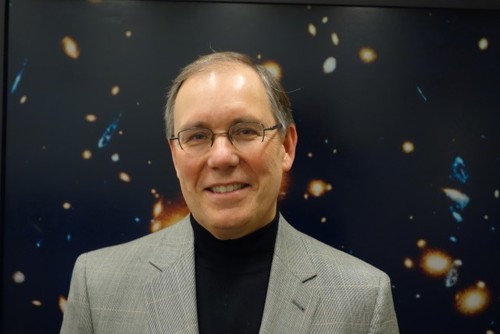
Portrait photo of Marshall Bautz.
Illinois & Balliol 1973
Born in Parkersburg, West Virginia in 1952, Marshall Bautz studied at Cornell before going to Oxford to read for a second undergraduate degree in physics and philosophy. He returned to the US, completing his PhD at Princeton before moving to MIT for postdoctoral work. Bautz has served in leadership and advisory roles for the development of science instruments for a number of space missions flown by the US National Aeronautics and Space Administration and the Japan Aerospace Exploration Agency. Since 2008, he has been the Associate Director of the MIT Kavli Institute for Astrophysics and Space Research where he is also a Senior Research Scientist. Bautz is a strong supporter of the Rhodes Scholarships and in 2023 he took part in the Rhodes Trust’s Technology & Society Forum, discussing ways to pioneer a sustainable space economy. This narrative is excerpted from an interview with the Rhodes Trust on 13 March 2025.
‘I was absolutely sure I wanted to be a scientist and not an engineer’
I was born in West Virginia but I grew up in suburban Chicago, mainly in Chicago Heights. In high school, I was interested in a lot of different things, including math, science and history, and I also got interested in economics. My father was an engineer, and at that time, I was absolutely sure I wanted to be a scientist and not an engineer. Now I realise that I have the temperament of an engineer much more than that of a scientist.
Outside of school, we spent a lot of time playing baseball in the summer and just running around outdoors all day until the sun went down. As I got older, I got very interested in cars, fixing them and doing a little bit of competition, and that’s a passion that’s continued throughout my life. I also developed an interest in architecture, because the suburbs we lived in were pretty close to Frank Lloyd Wright houses, so I spent a lot of time as a kid with a drawing board.
On applying for the Rhodes Scholarship
I arrived at Cornell having very much wanted to go to Stanford because they had a year abroad programme. But I wasn’t accepted, and my reaction was to work really hard on academics at Cornell, probably to the detriment of my social development. I majored in physics and economics. The end of my freshman year coincided with the time of Kent State and Jackson State, and the university just decided to shut classes down right before final exams. I was pretty disillusioned with the student radical movement at that point.
I was still interested in studying abroad, probably because my mother was born in Norway. We had a lot of family and we had spent a summer in Europe. But it was only in the fall of my senior year that I started to think about the Rhodes Scholarship, because I got a letter from my university asking me if I was interested in applying. Without that, it just wouldn’t have occurred to me, and I certainly never expected to win.
In the final round of interviews, I got called in to be interviewed a second time. When they read out my name later in the day as one of the four people they had chosen, I just sat there and was really awestruck. I remember my dad was waiting to drive me home afterwards and when I told him I’d been selected, he didn’t say anything. Then, on the drive home, he asked whether I thought it was a good career move. I couldn’t believe he would say that! But he was an engineer and I think he just thought, ‘How is he going to learn any physics at Oxford?’
‘Real physics and real philosophy’
I spent the summer before I went to Oxford in Europe, travelling with a Eurail pass and a tent. When I got to Oxford, I lived in Balliol and it was amazing. You had this person called a scout who would come and tidy up your room, and you could take a bath but there were no showers. But I thought it was a great. I had this room with a view of a beautiful English chestnut tree. It was all enchanting and you felt like you were living in a fairytale.
I studied physics and philosophy and what I liked about that was that it wasn’t only philosophy of science, but real physics and real philosophy. I loved the tutorials, although I’m not sure it was enough discipline for me to really focus on the physics as much as I could have. And for philosophy, I had to write essays frequently, which was not something I had done before. Overall though, I was not as driven to get the best possible mark as I was at Cornell. I knew I needed to take a little more time to do what I wanted to do rather than what I thought I had to do. One of the things I really liked was the music that was available in Oxford. Every night, you could go and hear something. I also went to church a good deal, and spent quite a lot of time in the pub too, and I continued travelling in Europe during the Oxford vacations. I went with friends up to Scotland, and to central Europe and Yugoslavia.
‘It was just one thrill after another’
Even before I went to Oxford, I knew I wanted to do a PhD. I chose to go to Princeton so that I could work with John Wheeler, because I had the arrogance to think that I could work on the problem of unifying how we study the physics of small matter and how we study the physics of the universe. It did not take long for the folks at Princeton to suggest that probably wasn’t the right thing for me to be doing! They thought I should work in an observational cosmology group. That was good enough for me, and I never looked back. After that, I went on to MIT for my postdoc because there were people there using the same technology I had helped develop for my PhD which could look at visible galaxies to detect X-ray emission from galaxy clusters.
After my postdoc, I left to work in consulting for a couple of years before I was persuaded to go back as a research scientist. MIT had won the opportunity to build an instrument for an X-ray telescope and the plan was for a new Advance X-ray Astrophysics Facility to launch in 1989. But a few months after we started work, the Challenger Space Shuttle disaster happened, and the X-ray telescope we were working on was supposed to have been launched on the Space Shuttle. It took a long time before NASA felt comfortable launching anything again.
In the intervening time, I worked to help develop the sensor technology for Japan’s X-ray astronomy programme. That was the first time I was asked to get engineers and scientists to talk to each other and learned how to do that, and that was just a fabulous new experience. Going to Japan and living in that culture was extremely energising, and it was phenomenal to work on an instrument that actually got launched on a spacecraft. It was just one thrill after another with that whole programme.
After that, we all got back to working on the NASA mission. That had many, many more people working on it, and the engineering got a lot more complicated. It was a totally different experience, less thrilling but also more challenging. The stakes were higher, because the observatory was scientifically much more capable. That mission, renamed the Chandra X-ray Observatory, is in many respects the world’s most powerful X-ray telescope and is still operating 25 years after launch. In Chandra’s ‘first light’ image, we saw a beautiful picture of the remnant of a star that exploded in a supernova several centuries ago. Immediately we could see arcs of the various elements ejected from the star during the explosion, and, for the first time ever, the tiny neutron star at their center. It was a picture no one had ever seen before, and a very emotional experience I’ll never forget.
I take as much satisfaction in enabling other people as in doing my own science. My current role, serving as Associate Director of the MIT Kavli Institute, is principally about supporting the development of subsequent missions, coordinating multiple institutions and encouraging as much inter-institutional collaboration as possible. Another aspect of my work is trying to improve the professional lot of other research scientists in our institution, rearranging career paths, and I would say that’s one of the most gratifying things I’ve done in the last ten years.
‘I felt a desire to make sure others could get the experience that I had’
I’m really gratified at the efforts that are being made to extend the Rhodes Scholarship more broadly, and I’m especially interested in seeing more folks from Africa and more Native Americans benefit from the Rhodes Trust. I’ve always tried to support the Scholarship as well as I can, financially and in other ways, because I felt a desire to make sure others could get the experience that I had. Recently, I was involved in the Rhodes Forum on Technology & Society and it was terrific fun being back at Rhodes House and reconnecting with people. At this stage in my life, I find myself wanting to keep doing the science that I have been doing and wanting to enable others as well.
Interviewee: Marshall Bautz (Illinois & Balliol 1973) [hereafter ‘RES’]
Moderator: Jamie Byron Geller [hereafter ‘INT’]
Date of interview: 13 March 2025
INT: This is Jamie Byron Geller on behalf of the Rhodes Trust and today’s date is March 13th 2025. And I am here on Zoom with Marshall Bautz, Illinois and Balliol 1973 to record Mark’s oral history interview which will help us to launch the first ever comprehensive Rhodes Scholar oral history project. So thank you so much Mark for joining us in this project. Before we begin would you mind please saying your full name for the recording.
RES: Sure. My name is Marshall William Bautz III.
INT: Wonderful. And do I have your permission to record audio and video of this interview?
RES: You do.
INT: Thank you. So we are having this conversation virtually due to the magic of Zoom. But where are you joining from today?
RES: I’m in Lexington, Massachusetts in my home.
INT: Great. And how long has Lexington been home?
RES: I think we moved here in 1992, so a long time.
INT: Great. And you know to begin our conversation we’d love to go all the way back to the beginning and ask you where and when you were born.
RES: I was born in Parkersburg, West Virginia in January 1952.
INT: And how, did you spend your childhood in West Virginia?
RES: No actually by my first birthday we had moved to suburban Chicago, in Illinois. And that’s where I grew up.
INT: What town in Illinois?
RES: A few. We started with Park Forest. Moved a few miles to Chicago Heights. And then ultimately to another town a few miles further away, Flossmoor. So, but most of the time I was in Chicago Heights, yeah, for most of that.
INT: Who did you live with growing up?
RES: My mum, dad and sister, she is a couple of years older than I am.
INT: I would love to know Mark a little bit about your, perhaps your earliest educational experiences.
RES: Okay. I started kindergarten in the Flossmoor public schools. My folks had moved to Chicago Heights because it’s very much a middle-class suburb, Flossmoor was a little more wealthy but by some means, they’d discovered a loophole which allowed Chicago Heights students to go to the better schools in Flossmoor. And that’s, I went there through high school.
INT: Okay. And were there particular subjects or academic areas that you found yourself gravitating towards in school?
RES: [laughs] I like math a lot. I remember there was a reading competition in second or third grade or something like that which had all these coloured cards and various incentives that appealed to kids of that age. So, we had competitions both in math and in reading. And I guess I certainly was, by the time I was in high school I was interested in a lot of different things. Science was of interest by the time I got to high school. I was interested in history. And I got interested in economics because that was available to us at my high school.
INT: And what about, how were you spending your time outside of school during those years?
RES: I’ve tried to reconstruct some of that. We lived in a subdivision that had been built, I don’t know, in the late fifties. There were many, many kids running around all the time. We spent a lot of time playing baseball in the summer. I remember when we weren’t in school going out and starting to play baseball in the morning, coming home for lunch, going out again, coming home for dinner, and going out again until the sun went down. And you know there were never enough of us to have a full team or anything like that. So it was a very impromptu game, but those are very pleasant memories, I really enjoyed doing that. When I got old enough, I got very interested in cars also. And I, I firmly believe that there are some people that somehow are genetically disposed to like machines and cars and I’m one of those. So I’ve always spent time either trying to fix them or actually fixing them. And in some cases doing a little bit of competition with cars. But that’s been a sidelight, it’s not, it’s not something I tell everybody because some people don’t understand that. But when you are with other car people, everyone understands and I have a lot of fun with that.
INT: Is that a passion that’s continued throughout your life?
RES: Oh yeah, yeah. My aunt used to say I was born with a car in my hand. And I remember being really interested in cars when I was in primary school. I thought I had kicked the habit early in high school but that didn’t last very long. So I have always been interested in those things. When I was in primary school I used to draw cars all the time. And I remember making a big catalogue of cars from the 1920s, and the 1930s, and the 1940s. I don’t really know why that’s so interesting to me but it is. The other thing I guess I remembered in preparing for this interview that stayed with me is that I became interested in architecture at sort of a dilettante level. It so happened that the suburbs we lived in were all pretty close to Frank Lloyd Wright houses. And so it was possible to actually go visit them. And I just really, they really appealed to me when I was young. I later learned he wasn’t the greatest guy in the world but I still really like his architecture. And I spent a lot of time when I was a kid with a drawing board, drawing pictures of houses that, you know, I didn’t know anything about designing, really designing or real architecture. But that was of interest to me too.
INT: And you know it sounds like you had really varying and diverse interests during those later high school years. And I’m curious if you at that time had any notion of the direction that your career might perhaps take.
RES: I don’t think a very well formed one. My father was an engineer and I thought I was probably going to do something related to some kind of technical field. But I knew I wanted to be a scientist and not an engineer. I thought that science, in my pecking order at the time, was higher and also distinguished me from my dad, I think that was important to me at that time. Ironically I think I have the temperament of an engineer much more than that of a scientist. And actually part of my later life was bridging those two communities of engineering and science and what I did later.
INT: I’m really curious about that. How so in terms of the temperament of a scientist and the temperament of an engineer, curious about that.
RES: Yeah, I wish I could articulate that succinctly. But I think it’s a little difficult. For an engineer the most important thing is to build something that does what it’s supposed to do, that doesn’t fail. In order to do that the engineer has to understand a lot of different things, precise mathematical things, less precise rules of thumb and all of that. But good engineers somehow combine all of that together to produce something that works. A scientist is, ostensibly anyway, interested in understanding why things work the way they do and why the natural world does what it does. And they tend to be frankly a little more optimistic about their own abilities to do that than engineers feel about themselves and their abilities to build things that work. So fundamentally engineers tend to be more conservative than scientists. And I, if I talk to a scientist about some scientific topic, especially in astrophysics which has been my field, it’s good enough to get an answer that’s within a factor of 2 or 3 or even 10 of the right answer. And that’s satisfying to at least astrophysicists generally. But an engineer doesn’t care about any of that guessing about what the approximate answer is because that’s not good enough to build anything.
[00:10:04]
So scientists sometimes get impatient with engineers because engineers want more specific answers than that are interesting to scientists. So, and it turns out that a problem is that the engineers and scientists don’t even understand they’re in different worlds and talking different languages with one another. And so they just get impatient and that tends to get in the way of accurate communication.
INT: Interesting. Yeah I’m curious to know about, as we talk about your career a little later on, curious to expand on the ways that you [unclear 00:10:44] together. And did you go right from high school to Cornell?
RES: I did. Yeah. Yeah.
INT: Great. And what did you major in in college?
RES: Well I majored in physics and in economics both. When I got to college I had ideas about making economics a better science. [laughs] You know I was 17 I think and so I had all kinds of crazy ideas. At one point I wanted to major in economics and sociology because I thought sociology was a science, I’m not so sure it is but at that point I thought bringing those two together might make economics more successful. At that time I was pretty sceptical about how well-grounded economics was in reality. Now I think it’s actually quite well-grounded. I didn’t really pursue economics after I left Cornell but certainly now I think, it’s much better at what it purports to do than I thought when I was 17, yeah.
INT: And were there activities at Cornell that were important to your experience there outside of academics?
RES: Yeah, I have to say, and this is important, I arrived at Cornell having wanted to go to Stanford. And I was not admitted to Stanford. I was very surprised about that because school had been pretty straightforward and easy for me and I didn’t really have to work very hard in high school. And it was something of a shock that I wasn’t accepted at Stanford. My reason for wanting to go to Stanford was just that they had a year abroad programme, and, I just wanted to be able to go away for a year. So it wasn’t a very good reason. But anyway, I think in reaction to that I worked really hard at Cornell on academics probably to the detriment of my social development. I did have a group of close friends, you know, and I arrived in 1969 and so the counterculture was going and so we enjoyed pretending to be part of that to some extent. I did do a little bit of politics. When I was in high school I was on a debate team and through that became convinced that the Vietnam War was a bad idea. And so I had a very superficial, especially in my first couple of years, interest in politics and in the 1970 election I did some, you know, canvassing and that sort of stuff. But there was sort of a turning point. At the end of my freshman year, you know, it was the time of Kent State and Jackson State. The university just decided to shut classes down right before final exams. And by that time I was pretty disillusioned with the student radical movement. And although we didn’t have to take our exams and they were just, they were willing to give us a pass/fail grade in every course, I did take all my exams. And I remember being on campus pretty much, I felt like I was alone because a lot of people had gone to Washington for demonstrations at that point, or gone home because they didn’t have to finish their term. And I think I was estranged from politics through that whole experience. So later on there was a small cadre of folks that I hung out with that were interested in certain kinds of music. And I had a friend who was an English major and he tried to explain literature to me and I tried to explain physics to him. And that’s the sort of undergraduate stuff that I did.
INT: I would like to ask you about you, because you mentioned that part of the appeal of Stanford was potentially the opportunity to study abroad, and I’m curious as we start to think about your Rhodes experience, I’m curious about what it was at that time when you were coming out of high school and entering college and then perhaps even throughout your college experience that attracted you to the idea of studying abroad.
RES: Well it’s probably that my parents, my mother was born in Norway and she had a lot of family in Norway. Some family in the Mid-West in the US as well. So they, my parents, had gone to Europe a couple of times before I ever did. And then they took one summer where my mother and my sister and I spent the whole summer in Europe. I think I was 11 then. And we spent a lot of time in Norway but we also toured, you know, England, France, Germany. And I think that’s what made me want to travel more. So that, by that time that was something that was really appealing to me.
INT: Great. And at what point in your time at Cornell did you start thinking about the Rhodes Scholarship?
RES: It was the fall of my senior year and I got a letter from the university asking me if I was interested in applying. I wouldn’t have considered applying if they hadn’t because that didn’t seem possible to me at all. It wouldn’t, it just didn’t occur to me as something that could even have happened.
INT: And do you- Oh sorry please go ahead.
RES: No that’s okay.
INT: Oh I was- No, go ahead. Please.
RES: I hadn’t even thought about the Rhodes Scholarship.- You know, undergraduates have all these grandiose ideas and so I had plenty of those I think. My friends and I would talk about these kinds of supposedly deep intellectual topics which really weren’t very deep at all. So when I was asked to apply, I had already had an idea of what I would write about. I had to write an essay for them which turned into the Rhodes Essay. And so I think, because I had a subject ready to go, it seemed like it was a reasonable thing to try to do. But I never expected to win a Rhodes Scholarship.
INT: What did you write about?
RES: The title was something like, ‘Methodological problems in physics and economics.’ And the thrust of it was, again trying to understand why a discipline like physics seemed to be able to make progress and a discipline like economics at least to me didn’t seem to be able to make much progress. I think there were many subtleties which I didn’t appreciate, and I certainly didn’t answer the question, but I asked the question in the essay. And the people in interview committee seemed to be interested in that problem. So I think, I’m speculating here, I think they were interested in discussing it amongst themselves and weren’t too cognisant of whether I was capable of, yeah, answering the question myself. Anyway, yeah I still have the essay somewhere but I tried to find it in preparation for this conversation, I’m not sure I really would want to read it at this point. I think I understand answers to that question a little bit better now, not through my own work but just by reading. But that was the kind of thing that I was interested in at that time.
INT: And do you remember the moment of learning that you had been selected as a Rhodes Scholar?
RES: Yeah, yes I do.
INT: Would you mind sharing about that?
RES: There were two stages, at least there were then, of interviews.
[00:20:03]
And in the second stage, that’s the one that I remember better, the regional, there were- I think everybody, all the candidates were in the same room and we waited to, you know, to be called in for interviews and then called back or not. And it’s a really high pressure situation but everybody, you know, everybody in the room I remember being very supportive and entertaining. Some of the people were really funny, they really had comedic gifts. And I think I told you this one earlier but at one point one guy looked at me and said, “I’ll race you to the ceiling.” And that sort of captured the mood. I did, I think I got called in for a second interview, so I thought it was conceivable they would consider me, although I was even surprised about that. And they read the names of the four people they had chosen in alphabetical order, and I was the first one, and I remember I didn’t hear the rest of the names. It was just, I just sat there and I was really awestruck that that had actually happened to me. And I remember my dad, this was in downtown Chicago and my dad was waiting for me in the lobby of the building the interviews were held in. And he didn’t want to ask me whether I had been awarded the Scholarship or not. I think just because he didn’t want to make me say that I didn’t get one. And then when I told him that I had been selected, he didn’t say anything. And then on the drive home from downtown Chicago he asked me whether I thought it was a good career move. And I couldn’t believe he would say that. [laughs] But he was like that. He was an engineer, you know, and he was a very cultured and well-read person but I think he thought, well how is he going to learn any physics at Oxford? You know, I’m not sure what he really thought. But anyway, that was a little bit of a surprise to me. But there was no question in my mind that I wanted to accept for sure.
INT: And I think you shared when we last spoke that you actually spent the summer before you started at Oxford in Europe. Is that right?
RES: Yeah. Actually what happened was I did do that and the reason I didn’t join the [s/l sailing 00:22:45] group was that I was offered a job by the Lieutenant Governor of Illinois at the astounding salary of $1,000 a month, which was, you know, totally beyond my comprehension, but I needed to stay a little bit later than the sailing dinner or something like that. So yeah I, now that timeline doesn’t make a lot of sense, so I probably do not have that quite right. But I think I left in July and again actually went with my parents to Norway because they wanted to go. And then I left them there after a week or two and travelled myself through Europe, until the first week in October. And I had one of those Eurail passes and a tent.
INT: Oh wow!
RES: I was pretty much [audio distorted 00:23:40; possibly ‘by myself’] the whole time. So I had slept in the tent and could travel around wherever I wanted to go. So I went to Germany and Switzerland. I get mixed up a little bit about this. Italy for sure and I think a little bit of Spain on that trip. And I arrived by myself in Oxford the first week in October, maybe a day or two after the ’73 war in the Middle East had broken out. And that was followed by the oil embargo and all that stuff happened, yeah. So I didn’t meet any of my cohort until after they arrived, which I think was a little, a few days later, maybe a week later than I did. Yeah.
INT: And did you live in college at Balliol?
RES: Yeah both years.
INT: And what was that experience like compared to the experience of living at Cornell?
RES: Oh it was, well what was spectacular is you had a scout, you know, at least in those days you did. And so these people would come in and knock on your door and ask you if you wanted your room, I don’t know what they did, they tidied it up or something like that. And I thought that was amazing. There were no showers which was also amazing. You could take a bath if you wanted to. But I thought it was great. I had a room with a window viewing this beautiful English chestnut tree. And it was, yeah- You know it was eighteenth-century architecture, or nineteenth-century architecture really was not old by Oxford standards. But still it was decorative and you sort of felt like you were living in a fairytale land. At least I did. And then I had a, my dear departed friend <Name 00:25:46> lived two doors down from me and he was studying the same course I was. So he was the first American I met. He was a Marshall Scholar. And we hit it off right away. So it was a very positive experience.
INT: And what was that course? What course were you studying?
RES: Physics and philosophy. And what I liked about that was it wasn’t philosophy, only philosophy of science, it was philosophy and it was real physics, which is, yeah, which is really what I wanted. I think I really wanted to study philosophy. So that’s what we did. And Bob was doing exactly the same course, yeah.
INT: Okay. And was that a tutorial style format?
RES: Yeah. It was.
INT: Okay. And what was that like?
RES: Oh I loved that.
INT: I imagine physics in a tutorial style format is really interesting.
RES: Oh I’ll tell you, I had physics tutorials and I had philosophy tutorials. And you’re right, the physics tutorials were not the way I was used to learning physics. In the US you go to lectures, then you’re given some problems, usually out of a book that you have to solve and write down the answers on a piece of paper showing how you solve them. And then that got graded and you learned whether you knew or didn’t know how to solve those problems. The tutorial system for physics in Oxford was read this chapter in the book and do some of the problems. And if you have any trouble with the problems let me know. But that wasn’t enough discipline for me I think to really focus on the physics as much as I could have. But I loved doing the philosophy tutorials because Bob, as I said, was on the same staircase with me and we would alternate weeks. He would write the essay one week and I would write it the next week. And we would basically do all of those things together. We would talk through what the essay was. Of course we never wrote it until, you know, the night before the tutorial. We didn’t write them together but we definitely talked through them together, all of these topics. And then a lot of other stuff too of course. So I really enjoyed that. And I have a feeling that because I had to write so frequently, I didn’t have to do that really in either of the courses I had taken at Cornell, I think it must have improved my writing a lot. I don’t really remember. So it was really valuable. And I think it improved my thinking too because I remember he (Bob) told me after the end of the first year that I had come a long way in the precision of my thinking. So I’m sure that’s true. Probably not saying much but true. So that part I really liked. I definitely put much more into the philosophy than I did the physics because I thought I did really well at Cornell and I thought, well I know all this stuff. It was an undergraduate course after all. But probably, probably could have learned more physics. But I also was, I was no longer driven to get the best possible academic mark as I was at Cornell. And I think I knew I needed to take a little more time to do what I wanted to do rather than what I thought I had to do.
INT: Yeah. I’m curious what those things were. What was driving you at the time?
RES: I’m trying to, you know, I, I- I’m- Bob was always much more social than I was. We really were like this. Yeah.
[00:30:05]
So he did a lot more things than I did but what did I enjoy doing? One of the things I really liked was the music that was available there. And you know when I was back for the forum, I was reminded of that because there were all these placards you know of all of the music that’s going on at Oxford all of the time. You know you could, every night you could do something. And so I did some of that. What else did we do? I think we spent a fair amount of time in the pub. So and I was doing, going to church a lot then. My parents were sort of Mainline Protestant Lutherans. Liberal I would say. And that sort of came back to me in that era and so I started, I spent a lot of time at a very low Anglican church, partly because I had met a young woman who was interested in that. So that was a community that I was part of for a while. But the musical aspects that were most interesting to me were the boy choirs. I had done a lot of choral singing earlier in high school mainly, a little bit at Cornell. And these were just a revelation to me, the boy choirs. So I, yeah, it doesn’t seem like it should fill up all that extra time but it did one way or another.
INT: Did you continue singing yourself in Oxford?
RES: So I’m ashamed to say that I did try out for the St John’s Chapel Choir. And they took me for one week and then said, “Well you know,” I think they told me some story about how the headmaster said it turned out that all, all the people in the choir had to be from St John’s. But I could tell that they thought I wasn’t quite up to it and I think they were right. Because, yeah, those guys were a different class of musician than I ever was, yeah. So I tried. But yeah.
INT: And what was the experience like Mark of, you know, you had spent time in Europe previously and time in the UK previously. What was the experience of living in the UK like during those years?
RES: Well, I was astonished that it was such a different culture, is what it came to. And I think everybody who, yeah, it’s a commonplace that they’re really two cultures separated by a common language or something like that. But the thing I remember, the first jarring thing I remember was I was trying to figure out where to buy salt. And it turned out at least at that time you had to buy in a drugstore. And it took me the longest time to figure out, that out. [laughs] And that was, that was my first introduction to the fact that, you know, this is not the same culture that you are used to. But also, it was complicated by the fact that because of the oil embargo, there was an energy crisis in England as there was in the US. And so actually I had forgotten about this. But the Government decided that they were going to close commercial enterprises including stores except for food stores(?). You could only be open three days a week because there wasn’t enough coal to go around. And then the miners took advantage of this and went on strike and so then things really got bad. I may have that order mixed up. So it also was a culture that seemed like it was, it was coming apart, at least the political system wasn’t functioning very well. That may have been true at the same time in the US, because I wasn’t there I don’t really know. And that’s another thing that I remembered that was very striking. At that time we couldn’t get US newspapers, right. They were too expensive. So I only got British press. And I couldn’t make phone calls home but maybe once a term. And in order to do that you needed a couple of pounds worth of coins to stick in a payphone because, you know, there were no phones in our rooms or anything like that. So it was just letters. I felt completely isolated I think from the cultural environment in the US. So, I was surprised at how diverse the British press was too, right. It’s become the case here now too, but at that time every newspaper had a known political affiliation. And that was a bit of a surprise to me. So lots of different things.
INT: And did you, you mentioned your travels before you started in Oxford, did you continue travelling during your Scholar experience?
RES: Yeah, yeah, absolutely. So I tried to make a list of all the trips but as I say they kind of ran together. There was one we took to, we being mainly Balliol scholars of my years, I think E J Dionne and Chris Hendrickson and John Tillman and Bob went along on that too, I think I’ve got that right. And we went up to Scotland, the Isle of Skye, I think we must have gone to Edinburgh but I don’t remember. But again we had tents and we were sleeping outside. [laughs] I don’t know why we did that. E J of course is a famous columnist now and a political pundit. But he was interested in the possibility of a coming election. And I think there was one after that trip. And he was really interested the Scottish National Party. So that was one of the reasons we went up there. I took another trip to Central Europe, Southern Germany and Austria and Italy. And I think I’ve mentioned this to you before, and Yugoslavia. That involved Bob and Jim <Name 00:37:22> and Jim <Name>. And I have a picture of that trip, it’s the only picture I have that I could find. And let’s see, Bob and I went skiing in Austria. We went to Spain. And I had, my sister by that time was living in Stuttgart, she had married a US army officer who got posted there. So I made a couple of trips to see her too. Yeah.
INT: Okay. And is there, you know, reflecting back on your Oxford experience, is there, looking back on it from your viewpoint now, is there anything about it that you would change?
RES: Sure. I think it was a mistake not to sail with my cohort. Because I can see that those folks have much closer relationships with one another than I have with them. So I, I would definitely have done that differently. Let’s see, is there something else? I thought I wrote a, one other thing down there. Oh the other thing is, I couldn’t make any sense of what Rhodes House was for. And I think I didn’t, well I know I didn’t take advantage of it at all. And I guess maybe I was afraid to present myself there. But I certainly would have done that differently, especially since I had- [laughs] I had a really nice experience when I was there last fall for the forum. I had some work to do the day after the forum. I don’t know maybe I told you this. And I was permitted to go to the library and work there for the afternoon. And there were undergraduates there, must have been Scholars, and I could see that they were close, that they were using the facilities in a really productive way, both to get work done and to get to know one another and that sort of thing. And I’m not even sure that was available to us but I think it seemed to me that was a really good thing. Yeah. It’s a lot of collaborative learning going on there that I never took advantage of. My only real collaborator was Bob in the learning department.
[00:40:00]
INT: And at what point, or perhaps you knew before you even went to Oxford, did you start thinking that pursuing a PhD would be the next step for you?
RES: I knew that I was going to do that anyway. I had planned to do that before the whole Rhodes thing entered my life at Cornell. So I, I knew that I wanted to do a PhD in physics before I left Cornell, yeah.
INT: So had you applied to Princeton before going to Oxford?
RES: No I never, I, I didn’t have to do that because the deadline was after the Rhodes thing. I think I would have applied. I will say that one of the, jumping ahead a little bit, one of the impacts on my life of this Scholarship of course was every place I applied to when I did apply to physics graduate schools, admitted me. I think they were, people tend to be just over, you know, blinded by the fact that you have a Rhodes Scholarship in your past. So I got to pick where I wanted to go to grad school.
INT: And what attracted you to Princeton for that work?
RES: Well I was interested in- One of the outstanding, even fifty years later, one of the outstanding problems in physics is that we understand the physics or ordinary matter at small scales, like you know quantum scales, you’ve heard of quantum computers and all of that stuff. And we understand the physics of the universe at the very largest scales. That’s basically the theory of gravity which is in its latest incarnation developed by Einstein, called the General Theory of Relativity. And those two theories are inconsistent with each other. But the general presupposition in physics is that all physics must be unifiable in some way. And so, so [laughs] I had the arrogance to think that maybe I was equipped to work on that problem. And one of the premier experts on general relativity at the time was a guy named John Wheeler who was a professor at Princeton. And he actually came to visit Oxford and Bob and I went to his lecture. He, yeah I think he was there for a couple of days, so he did a few different lectures. So we went there and we actually got to meet him and talk to him and so on. So I wanted to go to Princeton because that’s where John Wheeler was. And I thought I could work on that problem.
INT: And did you?
RES: I did not. It, it did not take the folks at Princeton long to suggest that that probably wasn’t the right thing for me to be doing. [laughs] You need, you need all kinds of mathematical ability, ability and training that I didn’t have. And at the same time I think they could see that, you know, I liked cars, I liked machines and stuff like that. And so they suggested I work in an observational cosmology group. And cosmology is sort of the, you know, basically the realm of general relativity. So that was good enough for me. That was still close. I was still doing something on cosmic scales. And yeah I never looked back. I think that was really good guidance that they gave me and it turned out I really liked doing it too. So, yeah.
INT: And how long was that process you took to pursue your PhD at Princeton?
RES: I think it was done in four and a half years. Because I, and I probably should have stayed for a postdoc there but I, I thought that since I had spent two years of my life at Oxford I had to catch up. And so I wanted to get out of Princeton as soon as I could. And that was not good judgement on my part. I think it would have been good if they could have persuaded me not to leave so early. I could have used another year of maybe postdoc there or something like that.
INT: And you ended up going to MIT for your postdoc.
RES: Yeah. I wanted to go there because I got- So the topic of my dissertation was, I built an instrument that goes on a regular telescope, ground-based telescope to study celestial objects called clusters of galaxies. And so I did that. It wasn’t a great instrument but it was good enough to get me a degree and did, you know, did a little bit of research with it. But these objects I had learned about, they’re called clusters of galaxies because they are collections of galaxies like our Milky Way that are close to one another and actually gravitationally bound by it turns out dark matter which holds all of these galaxies in close proximity to one another. And you can see the galaxies from the ground. You can’t see the dark matter because dark matter doesn’t emit any light. But it turns out that you can see this hot gas, very hot gas in x-rays. And it was known by the time I was in graduate school that clusters of galaxies have most of their regular matter in the form of this hot gas. And there were people at MIT who were using the same technology that I had helped develop for my dissertation instrument to look at visible galaxies, to detect this x-ray emission. And it was thought that if you could characterise the x-ray emission you would learn something about dark matter and indeed that proved to be the case. You can’t learn too much about dark matter but you can learn how much there is that way. And I wanted to be part of using this technology we’d developed to measure the x-ray emission from galaxy clusters. And eventually, it took a long time, but I did get to do that, not in my postdoc actually but eventually. And that’s the reason I went to MIT. So that turned out to be not such a bad choice I think.
INT: And do you, did you join the faculty at MIT right after your postdoc?
RES: No, and that’s something in your summary that I need to correct. I have, I am not now and nor have I ever been a faculty member. There’s a research staff hierarchy as well as a faculty hierarchy. So I have been a research scientist there after my postdoc. Actually after my post-do I I tried consulting for a couple of years and then got persuaded to come back to MIT when finally some folks at MIT had won the opportunity to build an instrument for an x-ray telescope, and that’s why I went back there in 1985.
INT: Okay.
RES: It’s a detail but it’s an important one.
INT: Yeah, yeah, okay. So thank you so much for that clarification. So I would be really curious then about what those earliest years when you were asked to join as a research scientist again, what those were focused on.
RES: Well it, when I went back in 1985 the project was to work on something called the Advanced X-Ray Astrophysics Facility which was then expected to launch in 1989. And so just a few years. And basically nothing had yet been built and it couldn’t possibly have been launched by then but I didn’t know that at the time. And in the event, instead of launching in 1989, it launched in 1999 partly because right after I came back to MIT within a few months there was the Challenger Space Shuttle disaster. And this x-ray telescope was supposed to have been launched on the space shuttle. And so it was a long time before NASA felt comfortable launching anything. And there were things that were ahead of us in the queue to be launched. And so that’s really why it took so long. There were lots of other political and financial reasons too. So we had to find something else to do given that there was a delay. And the person I worked for at that time knew this- You know we’d helped develop the sensor technology, the sensors are called charge-coupled devices, CCDs for short, and that’s really what I know a lot about. The guy I worked for was asked by someone in Japan to provide a CCD instrument. Japan had its own very successful x-ray astronomy programme.
[00:50:00]
And of course you’ve got to do x-ray astronomy from space because the atmosphere absorbs the x-rays that we’re interested in. And they were planning a space mission that was going to launch in 1993 and they wanted to use our technology. And so from about 1988 to 1993 we were engaged in this, in developing this instrument. And I was so-called the project scientist for that, which meant that I was supposed to understand the science objectives and communicate them to the engineers who would design the instrument. That was the first time I was asked to get engineers and scientists to talk to each other and I kind of learnt how to do that. And that was just a fabulous new experience. You know like going to Oxford and living in the English culture, going to Japan and living in that culture was just a really energising experience. It was easy for me because the sort of outer culture of courtesy was really consistent with my personality. And the other part of it was we were trying to do something that had not been done and we were, there were not too many of us, a few maybe four or five on each side that were trying to build this instrument together. Japanese and the US. And we were all pretty young. And so we didn’t really know what was possible and what wasn’t possible. And that makes things a lot more fun than if you are an expert and know all the things you need to worry about, because it’s just a lot more nerve-racking. So I got to go to Japan a lot. I never did learn the language because my colleagues in Japan were so good at English. But I really liked going there. And after about a year it dawned on us that although we thought we understood the culture, you know, you’d ride the public transportation and people would have American slogans on their sweatshirts and stuff like that. And the impression is they’re imitating us, or they want to be like America. And then you realise that actually it’s got nothing to do with it. They just like the way the words look. I don’t think I really ever fully understood Japanese culture but they were always very accepting. And it’s really, it was a peak, experience of my life just to go through that. Also it was the first space mission where I helped to build anything that actually got launched. And that was a phenomenal experience. Once you build the instrument it has to get attached to the spacecraft and then the spacecraft has to get attached to the rocket and all that, it takes a long time. And when you finally get around to launching it, it takes another, months and months to make sure that the rocket’s all set and the spacecraft’s all set and the instrument’s all set. So the launch site in Japan at that time was at the very southern end of the island of Kyushu. And I spent, I don’t know, six weeks down there sleeping on a tatami mat in a Japanese inn and eating nothing but Japanese food. And I started to learn the language down there because very few people did speak English besides the folks we were working with. But also I had never seen a rocket launch before. And the Japanese were much more relaxed about safety rules. So we could get much closer to the launch than I could ever get to a NASA launch. And it was just one thrill after another that whole programme. And then the instrument worked when it got up to orbit which was, that is a thrill because you can’t fix it once it’s up there, you know. And you never know whether you did it right until, you know, you test the heck out of it as well as you can but you just don’t know until it gets up there how well it will work. But anyway, that was- And thinking about what I was going to say with you today, I realised that was in some sense another foreign experience that really resonated with me and I really am delighted I had. And I suppose indirectly the reason I got as far as I did, got to get to that experience, part of that was having a Rhodes Scholarship. I think that made it easier for me to follow that path. I continued to work with my friends in Japan through 2015 or something like that. They had a couple of other missions that we helped them with. So that has been a part of my life. And a colleague of mine who is taking over the group that I’m just stepping down from leading, was part of those later missions. So he is now working with them on their missions, yeah. So and that’s very gratifying to me too.
INT: That’s really lovely. Was that, was that a partnership between Japan and NASA? Or was the work that you did for NASA separate than the work you did in Japan?
RES: It was a partnership, all of those missions were partnerships. Some of them were funded by the US. So our work was funded in some cases by the US and some cases directly by the Japanese. But yeah NASA was involved in all of those things, all of those Japanese missions. But then after the launch of the first mission, which was called The Advanced Satellite for Cosmology and Astrophysics, I had to get back to work on, we all had to get back to work on the NASA large mission. So the NASA mission we were working on (the Advanced x-ray Astrophysics Facility got renamed Chandra. Chandra was much bigger than the Japanese missions. And had many, many more people working on it. And many, many more rules that had to be followed in building it to make sure that it was going to work, as a so-called flagship mission which basically meant there was a budget but NASA was committed to getting the thing done no matter what it cost, although they wouldn’t put it that way. But that also meant that it absolutely positively had to work and so the engineering gets more complicated because you want to maximize the chances that it actually does work. So that was a totally different experience, it was immersion in the NASA culture which is interesting but less thrilling I would say. It goes more slowly. But also it was more challenging, you know, the stakes were higher, because the observatory was scientifically much more capable. My work on the development of that project stretched from the early nineties to 1999 when it launched. Having been through the Japanese experience I had more responsibility in the Chandra project. We really didn’t have enough people in our group to do what needed doing. But there was another group doing a different part of the project at Harvard which, is close to MIT, a couple of miles away. And we’d each been funded by NASA to work on this, on different aspects of it. But we each felt we had more to do than we could do. And we discovered that by combining forces we could be much more effective. And that’s something that was not part of the NASA culture necessarily, NASA is sort of top down and every team gets its task and reports back up whether it’s successful or not. And this relationship we developed, it’s today is called the badgeless environment. You know each organisation has a badge and you wear the badge of your organisation. But I agreed with some of my colleagues from Harvard that we would just, we would not work that way. We would collaborate and share information on everything and that really made a huge difference in how quickly we could get things done. And we’re still working with those people today, Chandra is still operating.
INT: Wow. When was that launch, that initial launch?
RES: 1999.
INT: It was, okay.
RES: Yeah, and it’s still going.
INT: Wow, that’s incredible. That is really-
RES: It is incredible isn’t it.
INT: It really is. It really is.
RES: It was designed to work for five years.
INT: Wow. And would you mind sharing, you know, both the moment of what the launch is like.
[01:00:03]
I know you had that experience previously but if you wouldn’t mind explaining on that. And then you know you shared in our last conversation the moment of seeing the observations for the first time and I’d love to ask you about that.
RES: Yeah. Okay. Yeah well [laughs] I could talk a long time about the launch. NASA launches especially of these high value satellites are real productions. And my family and I got to go down to Cape Canaveral and watch the space shuttle launch. And I don’t know how interesting it is to go into all the details but of course as you know oftentimes a rocket doesn’t launch when it’s scheduled because something goes wrong on the countdown. So we had to stay down there for three days. But finally we got to watch it and it was launched at night. And it was just amazing. [laughs] Compared to this rocket I’d seen launch in Japan, you know, it’s sort of like the difference between a bicycle and a Mack truck. It’s just a totally different scale. And it’s always a thrill to watch something you’ve built leave the ground like that. And then you wonder, gee I sure hope it works. And it turned that it did. You can read a story about how that shuttle almost didn’t make it to orbit. That wasn’t known to us for many years afterwards but that’s not my story. So Chandra got up there and it took a couple of, by plan it took a couple of weeks, almost a month to get to the final orbit that it’s in. It’s in a fairly distant orbit from earth. And we’re on the ground waiting around for a chance to turn on our instrument until all of that got straightened out. And things looked pretty good to us. We could talk to the instrument and it all seemed to be going okay. And usually in a mission like this there is something called the first light target, it’s not really the first thing that you look at in space but it’s the, it’s supposed to be a spectacular object that gains a lot of attention for the mission, that’s basically the goal. So the object that we were looking at for the first light target was a remnant of an exploded star called a supernova remnant. And it’s name is Cassiopeia A because it’s a source in the constellation Cassiopeia that was known to admit x-rays. And nobody had ever had cameras as good as ones on Chandra in the x-ray before. And so it was thought that that was a good target to look at. And so we go through all the preparations to do that, point the telescope in the right place, get the instrument going. And then we have to wait for the data to get down to the ground which takes a little while. And a bunch of us were stuck in a little tiny instrument control room near the MIT campus. And we were sitting there waiting for the data to show up on the screen. And I was really worried because I could see that we were seeing, we were detecting an awful lot of x-rays, more than I thought we should. And I was wondering if the instrument was doing something strange. And then finally the image shows up on the screen and we see this beautiful picture. And the instrument is telling us where there are atoms of different elements distributed around this supernova remnant, something nobody had ever seen before. And then the most striking thing that we could all see, and I remember just pointing at it, was this tiny little dot in the middle of this halo of x-rays of different energies. And no one had ever seen that before. It was the remnant of the star that exploded. It was a neutron star. We didn’t quite know that at the time. But that experience, I have a picture of myself and the other people just staring dumbfounded at this screen. And I have my finger out pointing, “Look at that.” That is something I’ll never forget. It was a scientific revelation as opposed to a technical one. You know the earlier instruments we knew they worked but this, this was a very emotional experience. And I won’t forget it.
INT: Really lovely, thank you for sharing that. It’s such, it reminds me too of what you were sharing earlier of the bridging between engineering and science. And that in that moment the, that really drives that home for me, the way that, you know the work that you and your colleagues did, had advanced science in such meaningful ways.
RES: Yeah, yeah. Yeah I really take pride in having contributed, you know, many people worked to make that observatory possible. My contributions were really technical and maybe programmatic I guess I would say. I got to do some science with Chandra but the science that other people have done has in some sense been enabled by all of our work. And I certainly take as much satisfaction in that, in enabling other people as I do in doing my own science. And I think that’s just the path I have been following. Yeah.
INT: Lovely. Would you mind sharing Mark a little bit about your, the focus of your work in more recent years? And I know that you’ve just experience a professional shift. So I was wondering if you would mind sharing about that as well.
RES: Okay. Yeah it’s, let’s see, I think since the launch of Chandra I finally made it to be principal investigator of an instrument for one of the Japanese missions after that. And I was fortunate enough to have enough time to actually do some what I thought was gratifying science with that instrument. And this also concerned an aspect of galaxy clusters, though a different one than I had been working on in the early nineties. So I was really gratified by that. But about that time I was asked to serve as the Associate Director of the MIT Kavli Institute which is the organisation I have been working with all these years. And I decided to accept that. So that was really the last science I did directly myself. One focus of my work as Associate Director has principally been supporting development of subsequent missions, not necessarily x-ray missions. The major mission that our Institute had developed in that intervening period is not an x-ray mission but an exoplanet mission, that is, a mission designed to search for planets around nearby stars, stars near to the sun so that we could study the planets in more detail and perhaps determine whether or not there were any hints of life there. But also to understand how planets come to be and how they evolve and all of that sort of thing. That was a question of coordinating multiple institutions that were working on the satellite and the instrument. And there was a lot less collaboration than I think there should have been. And part of my job was to try to encourage as much inter-institutional collaboration as possible. But you can’t build a satellite on schedule with a finite amount of money without somebody laying down the rules. It’s necessary that that be done but it’s sometimes really hard to do. That NASA mission, TESS, the transiting exoplanet survey satellite, has been in successful operation since 2018. I had no technical contribution to it at all really, though I did provide some management and programmatics support. Since then we’ve been trying very hard to convince NASA to do additional space missions and that’s pretty much what’s consumed much of my energy, so far without success. We do have another one that is in preparation now, which is basically a successor to Chandra.
[01:10:00]
It’s still being considered for development so I don’t know that it will be chosen, and if it were, I would be launched long after I’d be in a position to use it. But part of the reason I’m still working part time is I would like to help people who are trying to prepare that mission for acceptance by NASA. And the decision on that will be about a year. So I’m going to work until then for sure. And hopefully it will be successful. Another aspect of my work in the last 10 years is trying to improve the professional lot of the other research scientists at MIT, not at MIT as a whole but in our institution, our little subset of MIT. And that’s been very gratifying because MIT, the broader Institute, is just as interested as we are in trying to do that. And I had the chance to work with a lot of other departments at MIT and try to improve the career paths that are available to those people. So I would say that’s the other most gratifying thing I have done in the last 10 years is trying to improve their lot a little bit.
INT: Well shifting gears just a little bit Mark, we, you know, I would love to ask you a few questions about the Scholarship specifically. And you know you have been, we are so grateful for your continued support and continued service to the Scholarship and you know thinking specifically last year of your role on the advisory board for the [unclear 01:11:50] society forum. And was curious if you wouldn’t mind sharing a little bit about what has inspired you to stay involved with the Scholarship in these ways?
RES: Well I have to confess that I, I’ve, in terms of service I’ve only been involved very recently. I’ve always tried to support the Scholarship as well as I can financially because, it was such a gift. And I just felt a desire to make sure that others could have, and maybe more people could continue to have that experience. To be honest I haven’t been following all the details of what the Trust has been doing. But to the extent that I know about that, I’m really gratified at the efforts that are being made to extend the Scholarship more broadly. I’m especially interested in seeing more folks from Africa in particular benefit from the Trust. And I think my sense is that that is happening. And I think tha work is really important and it’s gratifying to me that you folks are doing it. I’ve had a very easy time in life. I’ve had lots of privileges and it’s not hard to want to extend those privileges to other people.
INT: Thank you so much for your continued friendship and support with the Scholarships.
RES: If I could just add, the reason I decided to do the forum was that as I come to this, the end of MIT part of my career, I was looking for new things to do. And it didn’t seem like a good fit to me but I was persuaded that it was worth trying to do. And I’m really glad I did it. I think I benefitted enormously. It was just terrific fun just being back at Rhodes House. But also connecting with folks at Rhodes House, which really was reconnection for me. So I’m grateful that I was asked.
INT: I was curious if you wouldn’t mind sharing at this stage of your career and this stage of your life, what would you say motivates and inspires you today?
RES: That was hard to write something down about. Everybody who retires wants to stay useful. And I think the best way I can do that is to try to provide some service to people who are less fortunate than I am. So far I haven’t figured out exactly what that is. But I think I will. One idea I have is maybe trying to teach at a post high school level to under-served people, to the extent I have something to teach them that would be useful to them. So I’m working on that. I also find myself, I have a love hate relationship with MIT as an Institution. I suppose everybody does with their employer. But I find myself really wanting to keep sustain science that I have been doing, that I have been enabling with others, to continue. And so one example is I will be spending a fair amount of effort for the next year trying to get this next mission off the ground. And I think that’s suddenly getting a little harder than I thought it was going to be. We’ll see. So maybe there is some way I can help that process along besides just providing the technical support. And you asked about family and you know, it’s inspiring too. [laughs] Melinda and I have a granddaughter. And she’s going to be two in a couple of weeks. Her name is Evelyn and she is inspiring in her own way. Mostly entertaining us and amazing us. I want to see her flourish. So I guess that’s a motivation.
INT: Wonderful. Is she close by your granddaughter?
RES: Yeah, yeah, she’s in Sommerville which is, I half an hour from where we live. So, yeah.
INT: And do you have one child Mark?
RES: Just one, Ben. And he and his wife live with Evelyn in Sommerville. He’s an emergency room doctor. So he works really hard.
INT: I’m sure.
RES: So now that I have some more time I can probably make his life a little easier too.
INT: Wonderful. I’m about to ask you just a few more questions about the Scholarship. And you spoke to a little bit, to this a little throughout our conversation, but what impact would you say that the Rhodes Scholarship had on your life?
RES: Thinking about that, I know it’s been immense but I’m sure it opened doors for me that I didn’t even realise it was opening. And the relationships and experiences that I had there, completely change my life in ways I can’t quite articulate. In particular my relationship with the late Bob <Name 01:18:45> is something that I will always hold dear. And I discovered this in going to a Cornell reunion, this is not exactly on topic, but I didn’t go to many Cornell reunions until recently. I felt the same thing when I went back to Oxford for the forum, it’s just liberating to go back. I don’t know if you’ve gone to any of your reunions. I think one of the reasons it is liberating is that when we were young, of college age, of university age, we saw the world so very much more optimistically than we do now. And I think that’s why it’s such a thrill to go back there because there is a tendency to adopt that world view again and think that anything is possible. And that’s a worthwhile experience to have too I think, be reminded that maybe there is, things aren’t quite as grim as we old folks think they are. And anyway it’s fun.
[01:20:07]
INT: And you know one of our, this oral history project is in part an opportunity to mark the upcoming 125th anniversary of the Scholarships in a few years, which is a really natural moment to reflect on the history of the Scholarships. But also a great time to look ahead to the future of the Scholarships and the next chapter. And so we’d love to know what your hopes for the future of the Rhodes Scholarship would be.
RES: Well I think I’ve already touched on it a little bit. I know it’s not feasible, it’s such a, it’s an expensive operation to provide this very, very rich experience. But I hope it could be extended to more people and in particular people that haven’t experienced anything like that at all. I was talking to a colleague the other day and I mentioned the case of Africa. But another issue that’s of great concern to me is our entire country is built on some really, on dispossessing the people that were here before the Europeans came here. And those people are in need in so many ways. I think, I think it’s the case that the number of PhDs awarded to Native Americans you can, in a given year you can count on one hand, which is, if it’s true, you should check it. We can take it out if it’s not. But that’s ridiculous and it just shows how far we have to go there. And I was tempted, I haven’t done it, to look up whether there’s, and maybe there has been, hopefully there have, some indigenous American scholars, you know, Native, North American scholars. So that’s something that I would find very gratifying. Anyway that general problem. But I know that you are addressing that and probably have thought much more deeply about it than I have. So that would be my hope.
INT: And lastly I would ask Mark if you have any advice that you would offer to today’s Rhodes Scholars.
RES: Can’t resist that one. There are two things I think I would say. The first is cherish your friends because life is short. And the other thing is, and I didn’t really mention this, something that I learned from an astronaut, as I said, Chandra was launched by the space shuttle and to be launched the astronauts have to actually go out there and make it possible for the thing to leave the space shuttle and go on its way. And in the course of the programme I got to know one astronaut in particular, not terribly well but well enough. And she was the one, her name is Cady (Catherine) Coleman, and she was the one who was responsible for making sure that Chandra got deployed once the space shuttle got into orbit. Astronauts in general are amazing people. They know what to do when things go wrong. But they are also people who really understand how to do hard things. And she relayed something in a talk she gave. I don’t think it was original to her and I’m sorry I don’t know who said this first, but the astronauts say it about any space mission, or anything hard really. It’s this: It’s not about you, but it does depend on you. And that encapsulates a lot of my experience. And I would suggest that for almost anything worthwhile that’s an something to keep in mind. Yeah.
INT: Well Mark I am so, so grateful for your participation in this project. And I just, I am, you know as I shared previously, I have such admiration for the work that you do and it is, it really is mindboggling to me that the work that you have done, just the ways in which it will advance science and has advanced science. So thank so much for your openness to sharing your story. And I would love to invite before we close if there is anything else that you would like to share.
RES: Nothing except that I’m really grateful for you inviting me to be part of this programme. And for the elegant way in which you have conducted this interview and all of our conversations. It’s so much fun to talk to you. I really appreciate it.
INT: Thank you so much, Mark, that’s so kind. And so I will end our recording there.
[Audio ends: 01:25:47]