
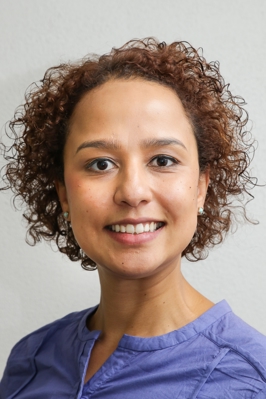
KwaZulu-Natal & St Antony's 2005
Born in the UK, Mandis Mbali moved to South Africa at the age of 11. A historian with particular interests in health policy and activism, she has always combined her academic work with human rights advocacy, working initially in AIDS activism and later for vaccine equity. She has held positions at the University of KwaZulu-Natal, Yale University and the University of Stellenbosch and is currently Associate Professor in Historical Studies at the University of Cape Town. This narrative is excerpted from an interview with the Rhodes Trust on 23 October.
‘I was already one of those people who questioned a lot’
My parents actually met at the University of Oxford. My father is a black South African man of Xhosa heritage, and my mother is white British woman. And at the time that they met and were married, first up, in South Africa, sex across the colour barrier was illegal, and secondly, all mixed marriages were illegal. Moreover, my father was involved in black consciousness activism, and therefore was forced to flee into exile. So, my father was actually a refugee, which, if I think about it, has shaped my interest in human rights advocacy and social justice.
My family moved back to South Africa in 1993, to Durban, right before our first democratic elections in South Africa. At my school, I was challenging the dominant sexist gender norms, asking why we had to wear skirts instead of trousers, for example, or why our sports houses were names after white colonisers. So, I was already one of those people who questioned a lot.
When I went on to the University of KwaZulu-Natal, my studies led me to major in history and then pursue a postgraduate career in history. I’m not a historian because I’m some sort of antiquarian who likes old stuff. I’m interested in understanding how societies work and how they’ve changed over time. I notice links between things, in ways that don’t immediately make sense to other people. I see the same thing in a lot of other Rhodes Scholars. We think outside the box, try and see things differently.
On applying for the Rhodes Scholarship
At university, I found myself taking up advocacy and activism after I had an experience when a man tried to grope me in a lift. I was so appalled, and I went to the student counselling service and they suggested I join the women’s student organisation. I did, but when I found that they were just offering social support, I was, like, ‘What’s the point in us just sitting around moaning? We need to organise against this stuff!’ I ran for the students’ representative council, and then I suddenly started realising that AIDS was the biggest problem facing us at that time. So, I said, ‘What is the university doing about this? Where are the condoms? Where are the pamphlets? Why aren’t there marches?’ We formed a committee to try to activate social change around AIDS, but it was hard to make progress, because the social forces driving new HIV infections were so strong. What we were doing felt like a drop in the ocean.
Then, I read an article about a breakthrough in HIV treatment with antiretrovirals (ARVs), and we joined forces with the Treatment Action Campaign and lobbied for the university’s medical school to give ARVs to staff and students, free of charge, and they agreed. It was an immediate victory, but on the global scale, the issue of racism when it came to access to science and healthcare was massive. So, I was in the thick of all of that. I really liked doing stuff from behind the scenes, especially writing, because I’m a writer. And I believed, too, that I should stay behind the scenes because I was not an HIV patient, and I felt like they needed to lead the movement. It was an interesting position to be in, one I think a lot of Rhodes Scholars experience: how do you leverage a privilege to advance the rights of the most marginalised in society? It’s not about you. You want to use your skills, talents and opportunities to empower people. That’s how I’ve always thought about organising.
I wanted to write a book about where AIDS activism had come from, and I thought a good way to start would be to do a PhD, so I looked for funding opportunities and the Rhodes Scholarship came up. But I was, like, ‘How is this going to work?’ The Rhodes Scholars from my constituency had all, as far as I was aware, been white men of a particular stripe, and here I was, a socialist feminist involved in community-based organising. Anyway, I decided to throw my hat in the ring, although I nearly pulled out when the interview date clashed with an advocacy speaker tour I’d been invited on. But the chairperson of the selection committee encouraged me, and I got the Scholarship.
‘This is a privileged place. We’re going to organise and take up that space’
I remember arriving at Rhodes House for the first big dinner, and I was super nervous. Even the big, heavy doors made me feel, ‘Wow, I’m in a really important place’. But then Bob – who is a legend in the Rhodes community – made me feel so welcome, and I immediately felt, ‘Okay, I can do this’. I have to say, though, that the racism in parts of the Trust at that time was still hugely problematic. At that same dinner, the then Warden told us, ‘You know, the thing is, Rhodes’ life was disputed, but you’ve taken the Scholarship, so you shouldn’t criticise him’. It made me so mad. I thought, ‘I’m a historian. I can say whatever I want about a historical figure’. And in Rhodes House there were rooms named after British colonisers – like Alfred Milner, who didn’t think black people should have the vote until they reached a certain level of civilisation. So, first, I thought, ‘It doesn’t feel like I’m welcome here.’ But then, I was, like, ‘Okay. Let’s focus on the money. They’ve given me the money. This place is a privileged place. We’re going to take that money, we’re going to use the space, we’re going to organise and take up the space, claim the space’. And that’s what we did. A group of us began to meet as black Rhodes Scholars, including Keon West (Jamaica & Balliol 2006), Sindiso Mnisi Weeks (South Africa-at-Large & New College 2005) and the late Eusebius McKaiser (South Africa-at-Large & St Antony’s 2003). It started as a social thing, but soon we morphed into becoming more like an advocacy organisation. And we were joined by others, including Seán Muller (South Africa-at-Large & Balliol 2007), and it became an example of allyship, with the common purpose of ending racism.
Despite that group, though, I did feel incredibly lonely through this whole process. My academic work was going really well – I’d already been working as a researcher in South Africa, so that side of things wasn’t as new to me as it was to some Scholars – but the incidents of racism and the fight to try and get the university to take action left me feeling exhausted. And also, I struggled with money, because at that time, the allowance wasn’t necessarily enough for those from more modest backgrounds. I’m glad to say that has now been addressed by the Trust. And I have to say two things: first, that from a scholarly point of view, I’ll be eternally grateful to the Rhodes Trust, because I managed to get the job of my PhD done; second, that the fun side of Oxford was really good. I rowed, and I went to balls and parties. There’s a Harry Potter element to Oxford that can be a lot of fun.
‘You’re there for a reason’
After a postdoctoral position at Yale, I finished my Oxford PhD and then I went back to South Africa to become an academic. It was a very different life: my focus was on my students and on lecturing and publishing. I stepped away from advocacy. But then, I found myself drawn back into that public space because of COVID-19, when I saw the same health equity concerns arising that had been prevalent during the struggle against AIDS: issues around the right to healthcare, around corporate greed, political inaction and preventable deaths. And I think one of the really powerful things we ought to do as the Rhodes community is leverage our social bond to facilitate convenorship in these areas. Because, you know, as Rhodes Scholars, we’re not just supposed to be bookworms. We’re actually supposed to want to make the world better and show leadership in that way.
To today’s Rhodes Scholars, I would say: don’t feel inferior You’re there for a reason. It’s important to focus on your studies, obviously, but also, enjoy it: the social life, the fun times, all of that. Because sometimes, I was, like, ‘Got to be serious. Got to fight the world’s fight’, and that’s important, but also, like, smell the roses. Go punting, you know? Just enjoy.
I think another important thing current Rhodes Scholars need to do is tell other good candidates, particularly those from historically disadvantaged and marginalised groups, to apply. Pay it forward. The kind of people who are going to promote human rights, social justice, climate justice, all of those things – we want those people in our community.