
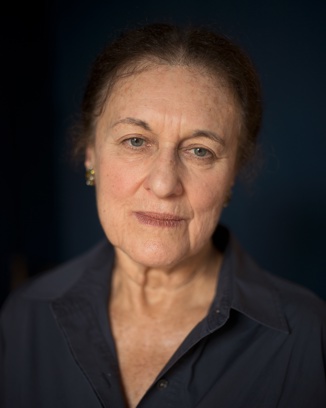
Photograph of Lyndall Gordon.
Rhodes Visiting Fellow & St Hilda's 1973
Born in Cape Town, Lyndall Gordon studied at the University of Cape Town and Colombia University before coming to Oxford as a Rhodes Visiting Fellow. She later returned to Oxford to teach English and American literature and to continue her research, primarily on T.S. Eliot. Gordon is the author of eight biographies and two memoirs, including The Imperfect Life of T.S. Eliot and Lives Like Loaded Guns: Emily Dickinson and her Family’s Feuds. She is a Fellow of St Hilda’s College, Oxford and a Fellow of Royal Society of Literature and has received numerous awards for her work including the James Tait Black prize for biography for Virginia Woolf: A Writer’s Life. Gordon’s revised and updated Norton edition of T.S. Eliot: An Imperfect Life, came out in 2026. This narrative is excerpted from an interview with the Rhodes Trust on 27 February 2026.
‘My mother was very influential in my life’
Cape Town, for me, meant nature, the landscape, the mountains rearing straight out of the sea. I grew up swimming a lot. When I was growing up, I would never have imagined coming to Oxford. In those days, it took two weeks for ships to reach England.
My father was a lawyer in Cape Town and very much concerned with sport. He had been to the South African College School which had its own Rhodes Scholarship at that time. He said he would have been in line to get it, but my grandmother, who was very small-minded, persuaded him just to get going with his legal career.
My mother was very influential in my life in that she was writing poetry. She eventually became a Bible teacher, teaching women’s groups around Cape Town, including a friendship club that was cross-racial. Apartheid was, of course, imposed on South Africa at that time, and my parents were vehemently opposed to it. They voted for Alan Paton’s Liberal Party, which was eventually banned. My mother was a semi-invalid and an impressive person: very high-minded, very politically aware. She read me a lot of poetry and fiction and she was brilliant at reading aloud. She was absolutely given to books and we had all the classics in our house.
I went to the University of Cape Town and did English and history as my majors. I also did anthropology under a professor called Monica Wilson. What I remember most was just the huge difference between hearing Monica Wilson lecturing about the Tswana and other South African peoples and the Bantu languages, compared to the way history had been taught in our school textbooks. Those were absolutely biased and twisted. They didn’t go back beyond the colonial period and every history lesson began with the arrival of Jan van Riebeeck in 1652 from The Netherlands, like history began with the white man’s arrival.
‘I just fell in love with American literature’
I did a one-year postgraduate degree in English, because that was the subject I really loved. While I was doing that degree, I got married. My husband was going to England for year to work in a lab in London before going on to the Rockefeller University in New York. So, I found myself in New York, and I decided to enrol at Colombia University to do American literature, which I hadn’t done before. I just fell in love with it and I was going to do a master’s, but everyone seemed to be going for a doctorate, so that’s what I did too.
I had studied T.S. Eliot’s poetry and I decided that this was what I wanted to focus on. My first thoughts were about Eliot as a New Englander. I was interested in the introspection, the strenuousness and the impeccability of those seventeenth-century migrating Europeans who had settled in New England, among them Eliot’s forebear, Andrew Eliot, who was among 11 jurors in the Salem Witch Trials who later repented. I became a kind of student assistant to Sacvan Bercovitch who was opening up the Puritan period for study, and he became my supervisor. At that time, the New York Public Library discovered that they had Eliot papers in their archive, and that was an absolutely trove of material. I looked at Eliot’s The Waste Land manuscript and I began to narrow in on Eliot’s interest in the religious life in his early years.
Sacvan Bercovitch had suggested I go and speak to the Eliot scholar A. Walton Litz, and he had been at Rhodes Scholar and had very good memories of Oxford. He was really keen on the work I was doing and put me in touch with other Eliot scholars, including Dame Helen Gardner who was Professor of English here at Oxford. Her book on Eliot was famous. To my surprise, she wrote to me, because she was interested in what I was doing on the fragments of the Waste Land manuscript that I had found in the Berg collection.
On the Rhodes Visiting Fellowship
In 1973, when I was just about to defend my dissertation, I saw a small notice on the English noticeboard at Columbia about fellowships being offered by the Rhodes Trust to graduates. Each of the five women’s colleges in Oxford was allowed to offer one of these. I applied, but I hardly thought about it after that, because it just seemed so improbable that I would be accepted. Then another letter arrived from Helen Gardner saying that she was coming to the US to interview me for the fellowship. To this day, I feel grateful both to the Rhodes Trust for making it financially possible and also to Dame Helen for being so positive.
Before I even arrived in Oxford, the English tutor at St Hilda’s asked me if I would be willing to teach tutorials as part of the fellowship. I really took to it. I didn’t have a great deal to do with Rhodes House, although I did go to the coming up dinner. I remember I sat next to the then Warden, Sir Edgar Williams, and he asked me, ‘What author do you like reading?’ I said ‘Virginia Woolf,’ and he just said, ‘Oh, she was mad as a hatter.’ I didn’t take it to heart, because I was quite happy with my own taste.
‘I loved teaching’
After Oxford, I went back to New York. In 1976, I was asked by the people running the selection for the American Rhodes Scholars to be part of the selection committee. I felt how strange it must be for them to have a woman amongst them, but they were very pleasant, and they explained to me in words of one syllable that we were there to carry out Rhodes’s will, not to exercise our private taste. They thought I was not going to be interested in sport, but in fact, there was one of the interviewees I favoured who was a long-distance runner. Even so, they wouldn’t have him, because they didn’t feel that was enough of a team sport. I remember feeling a bit outraged, because I thought he was extremely good.
What happened then is that my husband was offered a readership at the Dunn School in Oxford, so, we simply turned round and came back to Oxford. And without actually having a post, I did extra teaching, first just for St Hilda’s, and then, fairly soon, teaching the American option all over the university. I loved teaching it, not least because the students doing it were often the ones going for Firsts, who had chosen it precisely because it wasn’t English literature.
I published one volume, Eliot’s Early Years, with Oxford University Press. That was effectively a revised version of my thesis. There were all sorts of Eliot papers to which Helen Gardner had special access because she had been chosen by Mrs Eliot, who closely guarded Eliot’s papers. That was how I learnt more about Eliot’s muse, Emily Hale. I’d heard about her from Walt Litz, but Helen Gardner had by now discovered that Eliot went with Emily Hale to Burnt Norton, the site of the first quartet. So, she is there behind the ‘we’ of the poem.
After I had published my first book, I began to write about Viriginia Woolf. But then, I had a letter from a publisher in New York who asked whether, with the centenary of Eliot’s birth coming up in 1988, I wanted to write a sequel to Eliot’s Early Years. In the end, I decided to put the two volumes together. Later, I revised the books again, because new material was coming out all the time, and this revised version is what Norton has brought out very handsomely now.
‘It’s all bound up with mothers’
I’m still deeply interested in Eliot’s work. Although I’m not a religious person, I’m fascinated by the spiritual journey, and I think my mother’s spiritual journey was in some ways very close to Eliot’s. So, the view I have taken of Eliot’s life has been my mother’s view. She saw that Eliot was using his life in his work, and I wanted to pay tribute to her. I originally went to the archives with a question: when did Eliot’s religious life begin? And the answer was loud and clear in the early papers. That really went back to his mother, who was a poet too, and wrote spiritual poems. So, it’s all bound up with mothers.