
Born in Norfolk, Virginia in 1952, Larry Sabato studied at the University of Virginia and the Woodrow Wilson School of Public and International Affairs at Princeton before going to Oxford to read for a DPhil in politics. When he returned to the US, he continued to work for Democratic political campaigns, as he had done since he was a child. In 1978, Sabato became a member of the faculty at the University of Virginia, where he is now the Robert Kent Gooch Professor of Politics and the founder and director of the University of Virginia’s Center for Politics. He has also held visiting academic appointments at the University of Oxford and the University of Cambridge. Sabato is the author or editor of two dozen books on American politics and has won two Emmy Awards, including one for his 2014 PBS documentary The Kennedy Half-Century. This narrative is excerpted from an interview with the Rhodes Trust on 30 January 2026.
Larry Sabato
Virginia & Queen’s 1975




‘She slammed the door in my face’
My father was born in the United States, though only a couple of years after his family came over from Italy in 1913. He was a wonderful man, he was really my idol, and he accomplished a great deal for someone who had absolutely nothing. I remind people who are not sympathetic to immigrants that if they themselves have Italian or Irish ancestry, then 50 years ago, if it were today’s climate, ICE would have been after them.
My mother and my father both grew up in Virginia. My father was in one of the first waves of the draft for World War II and he never got a chance to complete even high school until much later on. But being in the Army-Navy Signal Corps was one of the great experiences of his life. He was stationed in Britain for most of the War until D-Day, and then he went over to Europe and fought his way up to Berlin, along with his comrades. My parents met on the naval base at Norfolk, Virginia, which was the major local employer. My mother was working as a telephone operator and she was actually my father’s boss at that point.
I was an only child and I loved to read. I went to the Catholic school where my mother worked because that meant they gave a discount on tuition. We had very little spare money but my parents always made sure I got books. I looked forward to December, not just because of Christmas, but because that was when we got the annual encyclopaedia update, and I would read it cover to cover. I had wonderful teachers at school who believed in writing and exploring your imagination.
I first learned about politics when I was seven years old. We were Catholic, and JFK was running for president and he was Catholic, and I was living in an overwhelmingly Protestant state. My father and I went down to the Democratic headquarters in Norfolk and got a bunch of Kennedy material and went door-to-door, passing it out. This apparently very nice lady who had bought candy from me before came to her door and, when I gave her the leaflet for JFK, said, ‘We do not support papists in this house,’ and then she slammed the door in my face. That’s stayed with me all these years, and it was a welcome experience, because it toughened me up, and that’s what politics does. It teaches you that people will never agree about everything and many people are going to dislike you because of what you believe, but you need to forge ahead anyway. Well, shortly after that, my father took me to a Kennedy rally in Virginia just before election day. With JFK present, the atmosphere was electric and I was completely hooked. Later on, I started working for a liberal State Senator, Henry Howell, when he was campaigning to be governor of Virginia, and I just rode my bike over to his house and asked to talk to him, and we hit it off. I learned so much from him over decades.
On applying for the Rhodes Scholarship
I always wanted to go to Princeton, and I was lucky enough to get a place. I thought I was heading there, but then an anti-war Democrat was running against a candidate who was very pro-Vietnam War. I was strongly opposed to the war, and I was asked to be the state-wide youth coordinator. So, I stayed in Virginia and ended up asking the University of Virginia (UVA) to take me in, and they did. It was a fortuitous happenstance, because I’ve been associated with UVA now one way or another for 55 years.
After I’d graduated, I went on to study at Princeton and then I applied for the Rhodes Scholarship. Part of it was that I didn’t want to disappoint Edgar, who had urged me to try out. When I learned I’d won the Scholarship, I rang home and my mother said, ‘Does this mean you’ll have to live in England?’ My father was thrilled. He’d been stationed all over the UK during the War, so he knew he was going to be coming to see me and visiting all his old haunts.
‘Everything about Oxford was different’
My class of US Rhodes Scholars sailed over to England together on the QE2, and that’s where I really got to know some of the people who would become my lifelong friends. Everything about Oxford was different, including the rigid English class system, which blew my mind and to which I never fully adjusted. I was reading for the DPhil. They needed tutors in American politics, so, very quickly, I was tutoring undergraduates as well as doing my own research, and I loved that. We learned from each other and there was a lot of comparing American politics and British politics. I’m still in touch with some of my students from that time.
My parents did come over to visit me, and we did go and look at my dad’s old haunts, as he had promised. I also got the chance to travel with friends, and I remember particularly that a group of us, including Michael Sandel (Massachusetts & Balliol 1975), Scott Matheson (Utah & Magdalen 1975) and Joel Goldstein (Missouri & Brasenose 1975), decided to go to Israel. By chance, we were there on the day that Menachem Begin would become the next prime minister. There were tremendous demonstrations everywhere and we were just mesmerised by all of it.
‘We cannot have a republic if this continues’
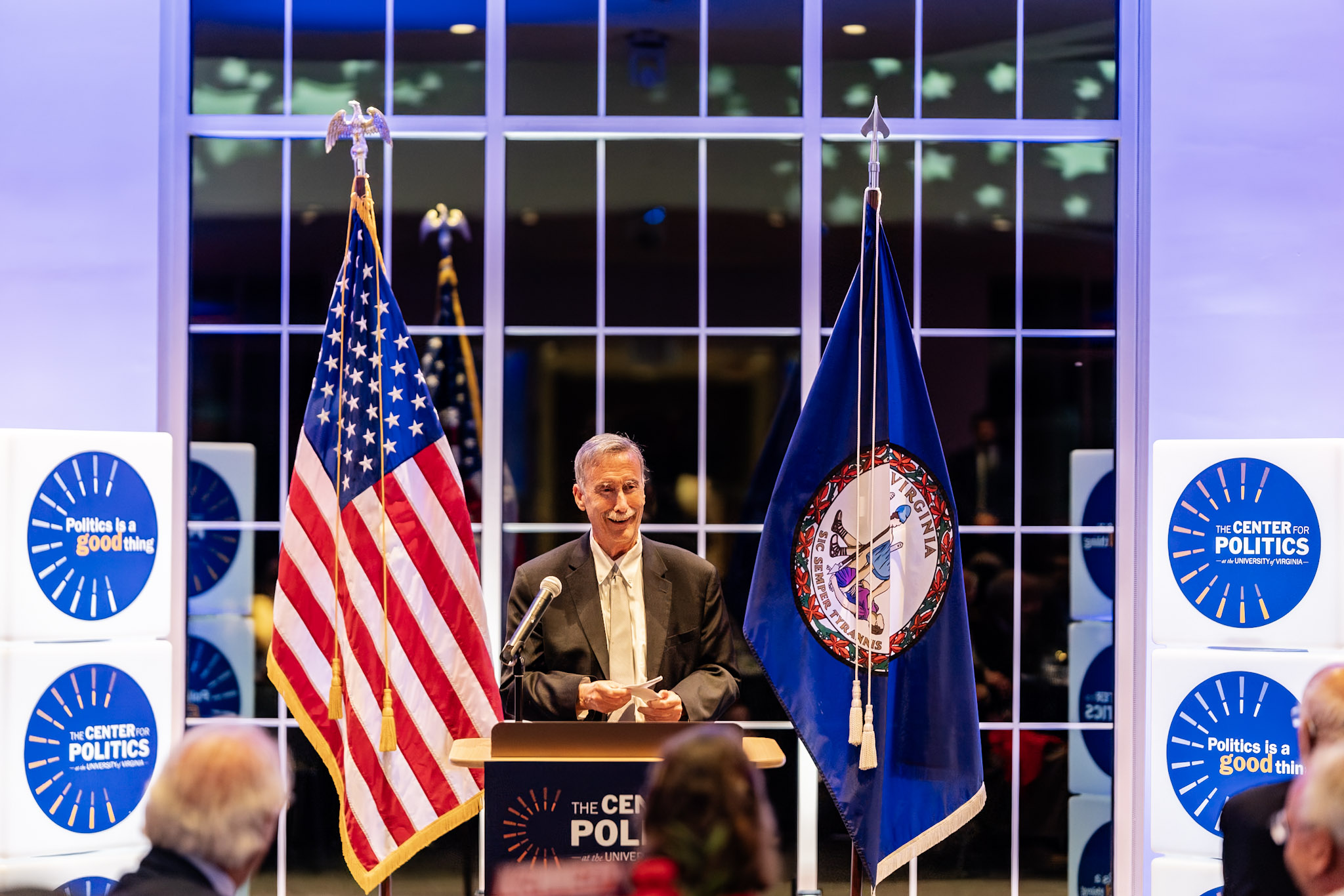
I was back in the US and planning to head to Yale Law School when I got a telegram from the chair of the politics department at UVA telling me they’d elected me to an assistant professorship. That’s not the way faculty appointments should be made, but that’s how it was back then. Well, I told myself that I’d do it, teach for a few years, and then I’d go to Yale, but I never left UVA and I’ve had a wonderful life here in Charlottesville. I’ve taught over 25,000 students during my career. I don’t have any children of my own, but I try to take care of my students and my neighbours. I feed them when we have big ice storms or other disasters befall us. It’s a great deal of fun, and keeps me young at heart.
In 1998, I founded the Center for Politics at UVA. By then, I had realised that the problems with politics included the constitution, and the press, and political consultants, but the much bigger problem was the lack of civic education for the electorate. We’ve developed hundreds of free lessons for teachers at all levels. We’ve had several million students go through the programme in all 50 states and territories. We’ve been around for 27 years, and we’ve got Donald Trump, so what does that tell you? It tells you we have a lot more work to do. I have to say that there are downsides to getting this involved in public education and not just staying in a back room. I’ve had death threats, including one very recently—a serious one—from a MAGA true-believer, and anyone who says, ‘Oh, that doesn’t bother me at all,’ is lying. Now, the stuff that’s happening to me is minor compared to what is happening in Congress. In a period of just a few years, we’ve gone from an average of about 2,000 threats a year against members of Congress to around 10,000. We cannot have a republic if this continues. We must stop this, and that’s also what motivates me. Millions of us feel the same, and while we are in a difficult period, I’m optimistic about the longer-term future.
‘Don’t waste time!’
The Rhodes Scholarship made an enormous difference in my life. The one thing I’ve tried to remember from the mandate for the Scholarship is that you are supposed to serve humanity in a broader sense. Although I’ve fallen short many times, I’ve done better than I would have if I hadn’t been given the Rhodes Scholarship. It’s about asking yourself, what do you want your legacy to be? So, my advice to today’s Rhodes Scholars would be, imagine your legacy as soon as you can—then don’t waste time and get to work!