
Born in Fort Collins, Colorado in 1952, Ken Brown studied at Cornell before going to Oxford to read for a second undergraduate degree in engineering and economics. Returning to the US, he worked in nuclear and solar energy, later moving into general management and private equity. Among his many roles, Brown has served as a Corporate Vice President at the General Electric Company (GE), President of Skidmore Owings & Merrill (SOM), and Managing Director and Partner at One Equity Partners (OEP). Now retired, he and his wife Elizabeth are active in charitable organisations, including Immigrant Food and several community museums and art organizations. Brown has served on Rhodes Scholarship selection committees and continues to be a generous supporter of the Scholarship. This narrative is excerpted from an interview with the Rhodes Trust on 12 December 2025.
Ken Brown
Colorado & Christ Church 1975




On growing Up Between Lumber Yards and Ranches
Immigration is deeply important to me because it is central to the meaning of America. On my mother’s side, my great-great-grandfather came from a Scottish immigrant family in Prince Edward Island and moved west to Colorado during the 1859 Gold Rush. He eventually became mayor of the town where he settled. On my father’s side, my ancestors were Scots Irish Confederate farmers from Georgia and Arkansas who also headed west to Wyoming in search of a fresh start after the Civil War. My maternal grandfather’s family, who were Swiss-German in origin, emigrated to southeastern Colorado in the late nineteenth century and began a family ranching tradition.
My parents were both students at Colorado State University, and I spent my first year of life in student housing in Fort Collins. After graduation, my parents moved to my mother’s hometown of Colorado Springs where my father joined the family lumber business. My sister and brother were born a few years later. Sadly, my mother died suddenly of a cerebral aneurysm when I was nine years old. My father later remarried a wonderful woman who stepped into the role of mother for the three of us, and together they added my youngest sister to the family.
The family lumber business was started by my grandfather, Ken Brookhart. After graduating from the University of Denver, he worked for The Denver Post for several years, including an assignment in Colorado Springs. Watching the tremendous growth of the city after the Second World War, he decided to change course and start his own hardware and lumber business. Much of my childhood revolved around working at the lumber yard. When I wasn’t working there; I was usually on horseback at my grandfather’s ranch. That combination of family business and ranch life shaped me into what I like to call a kind of “accidental cowboy.”
At school, I was a science and math nerd. Having lost family members to cancer, my ten-year-old ambition was to use my microscope to find a cure. As unrealistic as that sounds now, it pushed me toward science and toward tackling big, unsolved problems. I was also active in student government during the Vietnam era, surrounded by classmates involved in protests, which influenced my political thinking. Alongside academics, I played football, ran track, and spent a few years playing ice hockey.
“I didn’t think this sort of thing was for engineers”
I chose Cornell after family friends persuaded me that it had the strongest engineering program among the Ivies. I was only able to attend Cornell because of the generous support provided by the Scott Paper Foundation and later the Cornell National Scholars initiative—a program created to broaden the geographic profile of Cornell by encouraging enrolment of students from outside of the northeastern U.S.
I majored in engineering, but Cornell’s liberal arts environment allowed, and in fact required, me to explore subjects outside of math and science. I became particularly interested city planning, architecture, and development economics—a case of serendipity than only became apparent to me much later in my career. An early seminar on electrical infrastructure made me realise there were also massive, unresolved problem around energy generation and distribution in the United States, and I wanted to be part of the solution. A major focus of my career revolved around energy.
The most influential professor I had was deeply interested in fusion power, and he was the one who suggested I apply for a Rhodes Scholarship. Applying for the Rhodes hadn’t crossed my mind at all. I assumed that sort of opportunity wasn’t meant for engineers. Even so, I didn’t apply as a senior. Instead, I planned to work for a few years and then attend business school.
I took a job with Stone & Webster Engineering in Boston, in part so I could continue rowing, which I had taken up at Cornell. I rowed on the Cornell varsity eight and went on to make the U.S. National rowing team and competed in several World Championships, including in 1974, when The U.S. eight won gold. It was while working at Stone & Webster that I applied for the Rhodes Scholarship. I was shocked to be selected given the quality of the other candidates around me, but it truly was one of those small life moments with outsized consequences.
“I looked like something out of The Great Gatsby”
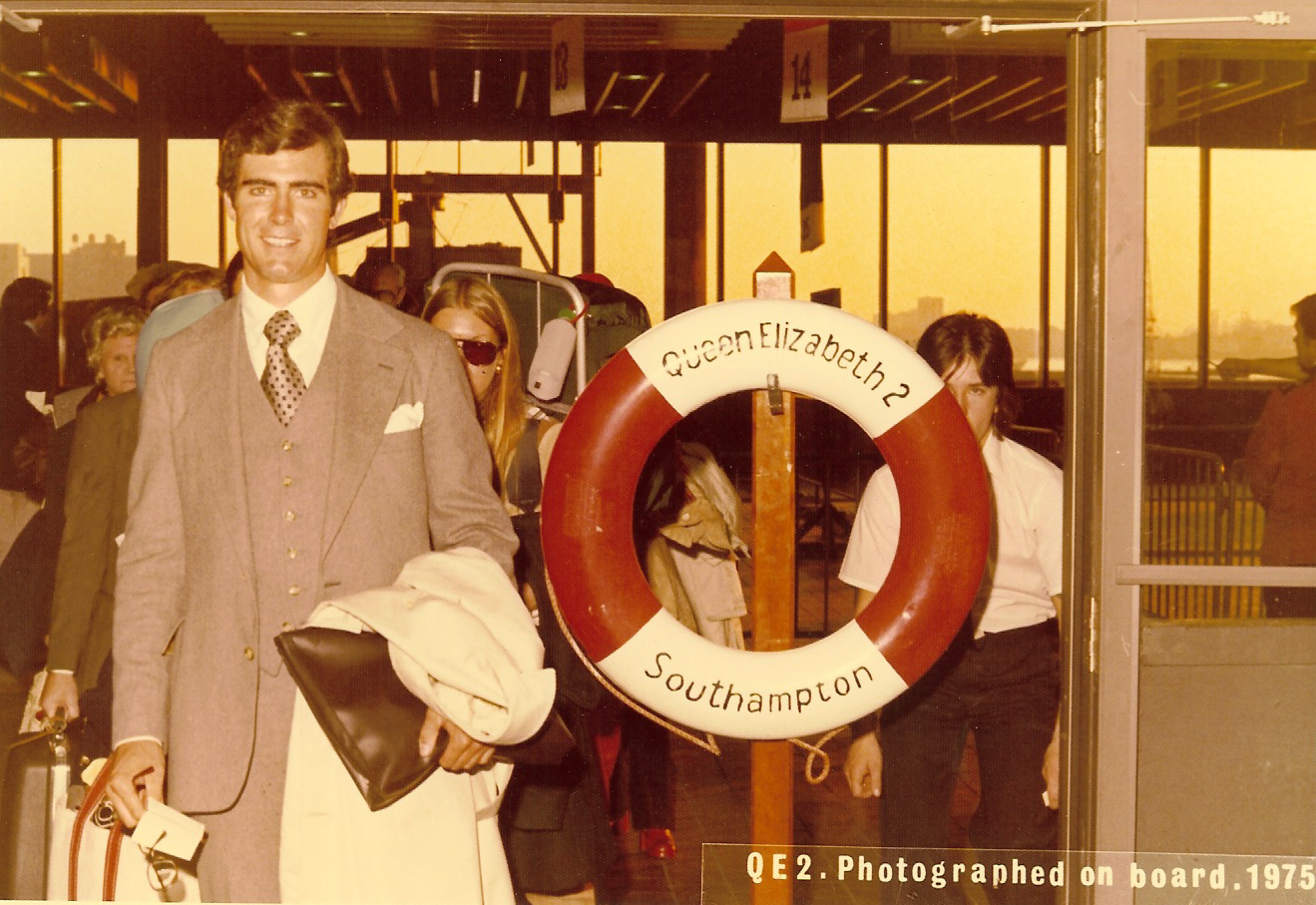
Our class sailed to the UK together, and that time was invaluable. It allowed us to coalesce before being scattered to our individual lives at Oxford. I still have a photograph of myself boarding the QE2 in a three-piece suit, briefcase in hand. I looked like something out of The Great Gatsby.
My first day at Christ Church, someone knocked on my door and said, “Mr Brown, I understand you rowed. You need to come down to the boathouse — we are assembling a crew.” Rowing integrated me immediately into the Christ Church community. I went on to row for Oxford in the crew that won the Boat Race in 1976 in record time.
The tutorial system was a difficult way to study engineering, but it taught me something far more lasting: how to write and how to argue clearly. In fact, my degree program at Oxford was called “Engineering Science and Economics,” and I paid equal attention to both worlds. Throughout my career, I was often the engineer who could translate technical results for people on the finance or business world who didn’t have a technical background. That skill has shaped every career success that followed—something I call “the bridge” --an ability to see, interpret and connect disparate disciplines (like engineering and finance) to formulate action and create progress.
A Career that Refused to be Linear
My first job after Oxford was with the newly created Solar Energy Research Institute (SERI) in Golden, Colorado. My job offer, which came sight unseen, was the result of a decision by a fellow Rhodes Scholar, Patrick Call (Oregon & St. John’s 1971), who was given the awesome job of selecting the initial cadre of employees for the Institute from stacks of hundreds of resumes from around the world. After my time at SERI, I joined Science Applications International (SAI), where I worked with teams developing synthetic fuels from oil shale and enhanced oil recovery technologies. Once again, I found myself acting as a bridge between engineering and economics.
I was then recruited by the Denver office of Price Waterhouse, which was looking for engineers with economic skills. I worked on strategic planning studies, operations analysis, project feasibility studies, and led a national practice to maximize investment tax credit utilization. After about 3 years with Price Waterhouse, my old friend Tom Barron (Colorado & Balliol 1974) referred me to the senior executives of a mining and energy firm that had just taken a major stake in his venture capital company. I was hired as Vice President of Strategic Planning and Development and moved to New York.
This new role with Inspiration Resources Corporation introduced a new dynamic into my career and into family life. Soon, I began to be called upon to “go to where the action was”—from New York to Arizona to California and beyond. However, the Gulf War recession caused a major reset in the resource sector, and after a period of consulting, an amazing offer to become head of strategy and development for one of General Electric’s primary business units, working for an up-and-coming senior executive, came along. It was back the East Coast for the family.
The changes didn’t stop. About a year into this first assignment with GE, I received a call asking me to become Chairman of GE Mexico-and a two-year expat assignment in Mexico City. That role was followed by a promotion to Corporate Vice President and President of GE Southeast Asia—and expat assignments in Bangkok and Singapore. I often asked myself what I was doing, especially as my children moved from country to country. But it turned out to be an extraordinary gift for them. They grew up fully in the world.
Near the end of my Singapore assignment, I was approached by a head-hunter about becoming the first-ever non-partner, non-architect leader of the prestigious architect-engineering firm of Skidmore Owings & Merrill (SOM). Again, a company was looking for someone who could “bridge” the worlds of design and business. While I did not achieve every goal I set for myself, I do believe that we created some useful change at that firm. Longing to return to the industrial world, I served as CEO of a battery technology startup—learning some hard lessons--before joining my old Cambridge rowing opponent and fellow U.S. rowing team member, Dick Cashin, at One Equity Partners, a part of JPMorgan. I spent fourteen very happy years in private equity at OEP. It turned out to be the ideal fit — a constant drumbeat of understanding how things work, how people make decisions, and how you can help businesses and individuals achieve far more than they imagined—always serving as the “bridge” between different worlds.
“The point of the Rhodes experience is the experience”
The most important thing the Rhodes Scholarship gave me was a worldview outside the United States.
Looking back, the same instincts that drew me to rowing — discipline, teamwork, and endurance — shaped my leadership and my philanthropy. During the first Trump administration, amid rising anti-immigration rhetoric, we decided to use food to highlight how deeply immigrant traditions are woven into American culture. Over the past six years, Immigrant Food has opened four locations in the Washington, DC area. My wife, Elizabeth, is the daughter of first-generation Cuban immigrants, and her mother helped found Hispanic Unity in South Florida, an organisation we continue to support. We have also championed programs to help struggling communities and populations in less developed parts of the world, such as the sustainable water treatment plants being constructed by Agua Clara Cornell and programs to ensure educational opportunities for girls such as Girl Rising and the Alliance for Girls.
Our other focus has been the arts. My wife, Elizabeth, is an award-winning photographer, has been a guiding force here. Together, we converted a building in Hollywood, Florida, into a nonprofit art gallery supporting emerging artists. Many of those artists have gone on to remarkable success. Elizabeth recently published her first book of photography focused on the winter landscapes of Hokkaido, Japan, and I was happy to lend bag-and-tripod carrying assistance all the way.
We are now working on a joint photography and writing project documenting life in the very smallest towns in Colorado, with the aim of fostering understanding and conversation across this country’s massive political and cultural divides.
To today’s Rhodes Scholars, I would offer the same advice I received before sailing to Oxford: take the time to enjoy everything that is there. Don’t worry too much about academics. Absorb the culture, develop side skills, and build lifelong networks. The point of the Rhodes experience is the experience.