
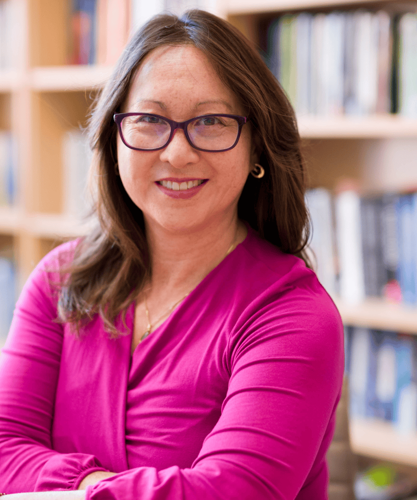
Portrait photo of Karen Yeung.
Australia-at-Large & Magdalen 1993
Born in Melbourne, Australia, Karen Yeung studied at the University of Melbourne before going to Oxford to read for the Bachelor of Civil Law (BCL). She remained in Oxford as a University Lecturer and Fellow of St Anne’s College while undertaking her D Phil and subsequently took up a Chair in Law at King’s College, London to help establish the Centre for Technology, Law & Society (TELOS), later becoming Director. Yeung’s research focuses on the legal, ethical, social and democratic implications of networked digital technologies, including artificial intelligence. She currently holds the post of Interdisciplinary Professorial Fellow in Law, Ethics and Informatics at Birmingham Law School and the University of Birmingham’s School of Computer Science. This narrative is excerpted from an interview with the Rhodes Trust on 12 August 2025.
‘It was quite an isolated experience’
I was born in Melbourne to Chinese parents who were immigrants from Hong Kong. My childhood experience was strongly coloured by three things. First, being visibly ethnically Chinese in what, to be honest, was a racist culture in Australia throughout the 1970s and 1980s. Being “othered” was my predominant cultural experience of growing up. Second, my Hong Kong Chinese parents adhered to a set of cultural norms concerning how children should behave and be brought up. I think it’s fair to say my mother was a “tiger mother” with an unpredictable and highly volatile temper. In some ways, this had some beneficial influences, but I was also conscious that my parents’ were quite authoritarian and much stricter than parents of my peers. Third, we lived for the most part of my childhood in a sort of semi-rural part of Melbourne’s outer suburbs which meant I couldn’t walk around the corner to meet up with my friends. It was quite an isolated experience. I did have my older sister though, thank goodness.
I very quickly learned to survive by keeping my head down, studying hard and being a “good girl”. I think it’s fair to say that people-pleasing has been my predominant approach to being in the world, often to my own detriment. I worked doubly hard to try to integrate into white society, attempting to behave and blend in with other (predominantly white) children. So, for example, and I deliberately avoided a group of Chinese girls who hung out together in secondary school to avoid being stereotyped alongside them. My own children now are very keen to know more about their Chinese cultural history and I have very little to share with them, which is a real source of sadness for me.
I had one teacher at the high school I attended who noticed that I had an unusual intellectual gift and he sought actively to nurture it, setting aside time in class to teach me mathematics at a higher level than my classmates. That made a huge difference: I relished the intellectual challenge. When I was 14, I applied for, and was awarded, a scholarship to one of the elite private girls’ schools in Melbourne. That meant moving to boarding school, and an entirely new environment which was utterly transformative. Overnight, it became acceptable to be smart and conscientious, and the racial taunts were more muted than had been at my previous secondary school.
On applying for the Rhodes Scholarship
I wasn’t sure what I wanted to do at university. I had enjoyed studying accounting at secondary school, and was planning to apply for admission to a Commerce degree. However, my mother suggested I should combine that with a law degree, which seemed like a good idea at the time, so I opted to study combined commerce and law degrees at the University of Melbourne. I had a wonderful undergraduate experience. During that time, I developed some great friendships with those who remain life-long friends, despite the geographic distance that has endured since I moved to the UK.
Once I embarked on the study of law, I found the intellectual quest to think liberating and exciting, although unfamiliar. By the time I hit my third year of my undergraduate studies, I knew I wanted to go further and deeper in my studies, and that’s where the Rhodes Scholarship comes in. I never, ever thought I would come close to winning, but it seemed to me it was worth a go. I just remember the application process and interviews being unbelievably tough, difficult and scary, but I got through it. I didn’t win the Scholarship at the state level, which felt pretty devastating, but I did go on to win one of the Australia-at-Large scholarships. I knew my life was about to change drastically, and in ways I could never have imagined.
“Let’s really try and pull this apart and make sense of it”
Arriving in the UK was exciting and rather intimidating. I remember running into a young Australian women when I arrived at my College digs who was super friendly and asked, impromptu, ‘Why don’t you come round for supper?’ It was a wonderful, reassuring way of starting my life in Oxford and she’s remains a dear friend today, several decades later.
Magdalen, my college, was filled with public school, white male undergraduates who exuded a born-to-rule mentality which I found deeply repugnant. And the food was just dreadful! But the building and grounds were very beautiful. In contrast to the culture there, I do recall being struck by the modesty of one senior Law Faculty academic. When asked by another new Australian student during a library training session if he was a member of staff, he merely replied ‘Yes’, making no attempt to identify himself a world-leading and highly acclaimed professor. I recall finding this understated self-assurance rather charming, a quality I found especially endearing some years later when spending a period of research leave at Harvard where I observed rather different tendencies.
One thing that has left a lasting mark for me throughout my time at Oxford, was (and remains) the University’s uncompromising quest for academic rigour. I loved the fact that you could engage in very heated debate, all for the sake of trying to better understand something. It wasn’t a matter of personal disagreement but simply a commitment to the quest for knowledge and understanding, ‘Let’s really try and pull this apart and make sense of it’.
At Oxford, I was no longer defined by being ethnically Chinese. For the first time in my life, I was defined by being ‘Australian’. I had a sense of being liberated from all those damaging and pejorative racial stereotypes that left an indelible mark on my experience growing up in Australia. It was certainly the time in my life when I became alive to myself as a woman with a sexual identity. It was great, it was heartbreaking, and all the other sorts of things that first love is, but it was wonderful.
‘I wanted to think about how technologies facilitate and enable social control’
I didn’t know what I wanted to do when I completed the BCL at Oxford, but I knew I wanted to stay in the UK. It was very hard to get a contract with an English law firm to complete my legal training because I had an Australian passport and, at that time, it was very difficult for British employers to recruit from outside the European Union. But then, in my final year of study at Oxford, I saw an advertisement for a tutorial fellowship in commercial law at St Anne’s College, Oxford, and thought to myself, ‘I could do that’. I had studied a number of commercial-type subjects and decided to put in application, which I promptly forgot about. When I was shortlisted, interviewed and subsequently offered the post, I was lost for words. The first year in in post was pure hell. There was no guidance at all, and it was really difficult, demanding and lonely. But I was in an environment that provided me with almost complete autonomy, which, of course is an incredible privilege, once you know what you’re doing.
Just before my first period of sabbatical leave, I attended a seminar at Hertford College at which the Chair of the Australian Competition and Consumer Commission (the ‘ACCC’) was speaking. I’d previously undertaken some research work for the ACCC as an undergraduate, and much to my surprise, the Chair remembered me, asked me what I was up to, and then invited me to undertake some research for the ACCC during my forthcoming sabbatical . It was a major intellectual change, and one which I thoroughly enjoyed. In fact, it was formative in establishing the direction of my future research career: the underlying conceptual foundations that I began to lay during that project continue to inform my ongoing research to date. My academic research is anchored, ultimately, in foundational principles which direct and constrain the exercise of authority and which I seek apply to novel technological contexts and settings. So, on my return to Oxford following that sabbatical, I worked on turning my ACCC policy report into a DPhil. It was tremendous to receive regular, guided research supervision from two outstanding academics. Their guidance enabled me to learn how to write critically and in a scholarly way and it was during that process that realised that academia was indeed my vocation and professional calling.
I remained an Oxford don for ten years. During that period, I developed my research in the broad field of regulation and governance. At that time, this was an emerging multidisciplinary field straddling law, political science, political economy, sociology and organisational management. Eventually, I felt the need to move outside Oxford, which, due to its flat structure, offered limited promotional opportunities, and after my long-time collaborator had moved to another University, there were no other faculty members who shared my research interests and with whom I could collaborate closely. Hence I left Oxford to take up a chair at King’s College London, where the Centre for Technology Law & Society was being established within the Law School. It was this move that provided the impetus for reorienting the focus of my research to emerging technologies. It soon became clear to me that I wanted to think about how emerging technologies are governed and how they enable and facilitate novel forms of social control.
‘Do not be thrown off course’
In my own life, I’ve been unbelievably lucky to land myself a partner who was prepared to be the primary carer of our children. I don’t know how I’d have managed otherwise. That would be my number one secret to ‘success, because the expectations and social norms that apply to professional women are outrageous and unreasonable, and I think, too, that we can be our own worst enemy.
The area I work on now (the governance of artificial intelligence) has academically mainstreamed, although, sadly, political leaders aren’t really interested in hearing what I have to say in the current political environment. Nevertheless, my professional mission, and the thread that runs through all of my academic work, remains concerned with holding power to account and to safeguard against its abuse. My childhood experience of a parenting approach in which an authority figure exercises unbridled, unconstrained authority without due regard for its impacts on others has animated and informed my professional mission to this day.
In offering guidance to young people, I would encourage them to avoid specialising too early if you’re unsure. To those who think they’ll never find their calling, I would say that you’ve just got to believe in the value of what you offer and do not be thrown off course by doomsayers. You have something valuable to contribute, you will find it within you if you continue to search and remain true to your foundational commitments.