
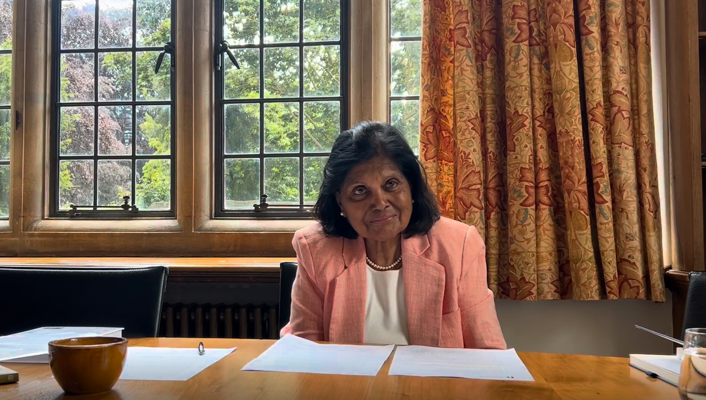
Rhodes Visiting Fellow & St Hugh’s 1975
Jeyaraney Kathirithamby was born in Kuala Lumpur and studied at Queen Mary’s College, Madras before taking her PhD at Imperial College London and going to Oxford as a Rhodes Visiting Fellow. At St Hugh’s, she went on to be elected to a Senior Research Fellowship and she is now an Emeritus Fellow of the College. Throughout her time at Oxford, Professor Kathirithamby’s work has focused on a group of insects known as Strepsiptera and the peculiar relationship between these endoparasites and their hosts. She is the co-author of Greek Insects and Maria Sibylla Merian. Artist Scientist, Adventurer (which won the 2018 Moonbeam Books Gold Award), and the author of Insect from Outer Space: The Biology of Strepsitera. This narrative is excerpted from an interview with the Rhodes Trust on 12 June 2026.
‘I sort of grew up with biology in my DNA’
My parents were Tamils, in the sense that they were from Sri Lanka but settled in Malaysia. I was born in Kuala Lumpur, and I had a very happy and magical childhood. I had two sisters and one brother, and my parents were wonderful people. I enjoyed their company and was close to both of them. I used to go for long walks with my father very early in the morning and we would end up having a wonderful South Indian breakfast.
I went to a mission school because most of the schools in Kuala Lumpur at that time were run by missionaries. I learnt English, and now I can only speak a little Tamil and I can’t read it, which is very sad. My mother tried to teach me Tamil, but I refused to learn it because I wanted to study English and go to English schools. I enjoyed school very much and had some very good teachers who guided me. I always liked plants and insects and on our walks, my father would show me various birds and insects, so, I sort of grew up with biology in my DNA.
On applying for the Rhodes Visiting Fellowship
I went to Madras to do my bachelor’s degree at Queen Mary’s College. Most of the time, I was just studying, but I also used to go to cricket matches, which I enjoyed very much. In fact, once, I watched the West Indians playing the Indians, and it was absolutely brilliant. After I finished my degree I went back to Kuala Lumpur, where I joined the university. I was teaching, but I got a little bit bored, because I was hardly able to do any research.
When I saw the Rhodes Visiting Fellowships being advertised, I was rather surprised, because at that time, women were not yet allowed to be Rhodes Scholars. So, I applied for the fun of it, really, and I was surprised when they invited me for the interview. The various women’s colleges advertised for visiting fellows from particular regions and I was interviewed at both St Hugh’s and Lady Margaret Hall. I remember that the interviewers were all fellows from the college, and one of the external assessors was the then Hope Professor of Entomology at Oxford, George Varley. He used to collect delphacids, which are planthoppers that were parasitised by the same group of insects that I studied in Malaysia. So, he was rather keen and he encouraged me during the interview, and I took up the St Hugh’s fellowship when it was offered to me.
‘I got hooked’
I worked with George Varley when I came to Oxford and he was very nice. His garden in Apsley Road up in North Oxford was like a field site. Initially, for two years, I just worked on a particular patch of grass there, collecting delphacids and looking at the biology of Strepsiptera, because very little was known about them. I had mixed feelings, actually, about working on something that so very few people knew anything about, but I just had this passion to learn more about them, and that’s why I got hooked. My fellowship was extended for a third year and I began looking at specimens in museums, but I got a bit frustrated and wanted to start collecting them live rather than just looking at dried specimens or those on slides.
I had no connection with Rhodes House except for one or two dinners there, which were very interesting, and this was during the time that Sir Edgar Williams was Warden. I meet Lyndall Gordon (Rhodes Visiting Fellow & St Hilda’s 1973) several times, which was nice, and St Hugh’s was and is very, very good to me. It’s very welcoming and a lovely college to be in. I enjoyed living in Oxford and I still enjoy living here.
‘It’s a very interesting insect and very unusual’
After I finished my Rhodes Visiting Fellowship I got a six-month fellowship to work in the Commonwealth Scientific and Industrial Research Organisation (CSIRO) in Canberra where they had the largest strepsiptera collection in the world. Most of the insects were preserved in alcohol rather than on slides, which gave me the chance to look at them on a three-dimensional basis and study their taxonomy. I described several families from Australia from that collection, and that’s how I widened my study to include more groups.
There are very few Strepsiptera found in England, so over the course of my career I have travelled a lot – to Japan, Australia, Panama, Brazil, India, New Guinea, Mexico, Italy, Spain and North America. To do that, I was funded by a number of groups, including the Royal Society, Linnean Society and the Leverhulme Trust. You have to know the particular spot to go to, and you have to go at the right time, because of the Strepsiptera synchronise their life cycle with that of the hosts. I had colleagues in various places who would give me the necessary information, and that’s also how I made friends with various people.
To study Strepsiptera, you have to rear the parasite from the host. The males only live for three to six hours and as soon as they fertilise the female, they drop dead. But the females all live within the host (except in one family) and do not emerge. Effectively, the female is just a bag of eggs. It’s a very interesting insect and very unusual, and that’s why I call it the ‘insect from outer space’ in my latest book. In Italy, we used to collect them from graveyards. In New Guinea, they parasitise longhorn grasshoppers which severely defoliate palm oil, so I used to go to oil palm estates. I’m interested in cooking as well, so it was intriguing on my travels to see various different types of food being cooked in different ways. I picked up South Indian cooking from my mother and I’ve also learned different techniques from Japan and China, and from New Guinea, where they wrap rice, vegetables and meat in banana leaves which they put into a hole they have dug surrounded by hot stones which create a sort of earth oven. Although I did go back to Malaysia when my parents were still alive, I have not gone back now for a very long time. Malaysia has now become very developed, and there has not been a tradition of collecting insects there, although I do have one specimen from Malaysia that was collected by Alfred Russell Wallace in Sarawak.
My first book, Greek Insects, which I wrote with my husband, is actually not about insects from Greece, but describes the insects on Greek vases and figurines and gems. My husband is a scholar of ancient Greek and it was his idea to write the book. He actually announced it at our wedding reception – which surprised me! I also co-authored, with Sarah Pomeroy, a book on Maria Sibylla Merian. She was a legendary figure in the seventeenth and eighteenth centuries: a German-Dutch painter and scientist and the first ever woman explorer. Her life was full of ambition, peril and persistence, and she was a pioneer because she was the first women to look at what is now known as metamorphosis but was little understood then, and this is the various stages that an insect undergoes before becoming an adult. People at the time thought that these beautiful butterflies and moths just emerged by the magic of divine intervention and spontaneous generation rather than through a natural process. So, she actually laid the foundations of modern entomology. She also drew and painted the insects as they evolved, and her observations were absolutely spot on. There are copies of her book in the Bodleian’s Weston Library and her drawings have also been exhibited at the Ashmolean. She was an extraordinary woman.
‘The Rhodes Visiting Fellowship dramatically changed my life’
I do feel that the Rhodes Visiting Fellowship dramatically changed my life. If I had stayed in Malaysia, I would have carried on teaching and not done any research at all. Coming here to Oxford opened up this avenue of working in Strepsiptera, which is one of the wonderful things that has happened to me. I was persistent in what I wanted to do, and the book I have published recently on Strepsiptera has opened the eyes of many people. It’s interesting that younger people are writing to me to say how interested they now are in this group. Alongside my own research, I have also been a co-supervisor to various students, and I very much enjoy that. My basic advice to people is to follow their passion, and I do feel I have done justice to my passion, which is to explore the wonders of the group of insects called Strepsiptera.