
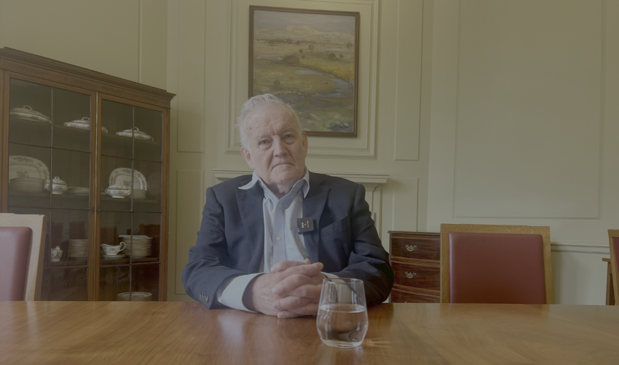
Photograph of Gavin Williams.
Cape Province & Trinity 1964
Born in Pretoria in 1943, Gavin Williams studied at Stellenbosch University for a BA in Legal Studies before going on to Oxford to read for B Phil in Politics for a BA in Legal Subjects before going on to Oxford on read student at Stellenbosch and again at Oxford, he was involved in the anti-apartheid National Union of South African Students. In Britain he facilitated scholarships for South African (and one refugee Ugandan!) student for Oxford Colleges and British Universities. They included Sam Nolutshungu (Manchester) and Marcus Balintulo (Durham) who would be appointed vice-Chancellors at South African Universities; and Emmanuell Tumusiime-Mutabile (Durham and Balliol).
Gavin was Lecturer in Sociology in 1967-1970, and 1972-1975 at the University of Durham; Research Fellow at the University of Sussex and Research Associate at the Nigerian Institute of Social and Econpmic Research from 1970-72. In 1975 he was appointed Fellow and Tutor at St Peters, a position he held as an Emeritus Fellow from 2010. associated with a Lectureship in Politics at Oxford University. Students can say no better of a teacher than 'He taught us how to think.' He supervised 53 successful candidates for D Phil theses, singly or jointly, from 16 countries. Nine were Rhodes Scholars, from six different countries - Australia, Nigeria, South Africa, Zimbabwe, India, and Canada. He examined 50 D.Phil (succesful!) D.Phil candidates at 23 other Universities. In 2013, he was awarded a D Litt by examination, in Sociology, Politics and History by Rhodes University, and in 2014. the U.K. Distinguished Africanist Award ‘in recognition of’ his ‘significant contribution during four decades of research and writing on the political economy of Africa’ and ‘leadership in the field of African studies and his inspiring role as a teacher and research supervisor’.
‘The other students pretty much regarded me as a communist’
I came from a very academic family. Both of my parents were academics and teachers. My two brothers and both of our children have PhDs. My father and brother were both mathematicians. I can’t understand any of what they do, but I always took it for granted that I would come first in Maths at school.
I went on to study at Stellenbosch where I was taught by certainly, I think, the finest philosophy teacher I’ve ever encountered, Johanes Degenaar. He was quite well to the left and anti-apartheid but he was an Afrikaner and he always put questions to us around those issues. Stellenbosch at that time was the cornerstone of Afrikaner nationalism. I enjoyed my time as a student, and I played sport and did all the other things students do. I stood for election to get a platform on the SRC (Student Representatives Council), and I think other students pretty much regarded me as a communist, even though, after the Hungarian revolt was crushed by the Soviet Union in 1956, I didn’t like the Communist Party much. I studied law, on the assumption that I’d go on to gain a legal qualification and become politically active as a lawyer, but then the Rhodes Scholarship intervened.
I think the reason I got a Rhodes Scholarship was that, like other applicants, I had a good academic record. I’d also been involved in student politics. But what made the difference was that I’d been to Stellenbosch and chaired a small branch of the anti-apartheid National Union of South African Students. I’d been to an Afrikaans university and got involved in student politics, and that was putting my neck out.
‘My special subject was Africa’
At Oxford, I read for the BPhil in politics, and my special subject was Africa. At that time, that didn’t include South Africa. My thesis was on the political sociology of western Nigeria and it involved a sort of macro and micro study of cocoa farmers in the region. At that time, I had not even been to Nigeria, let alone met a cocoa farmer. Nigeria has the largest population in Africa and it’s a very complex country, and therefore of great interest to a graduate student. I was taught by three great teachers and scholars, Philip Williams and David Goldey on Politics, John Plamenatz on Political Theory, and Thomas Hodgkin on Africa. Bill Johnson (Natal and Magdalen) I taught one another ‘International Communism 1917-1943. Alongside my academic work, my most important activity was working with other students in Oxford and with students in other universities, continuing to raise money for and support the National Union of South African Students.
‘An experience that changed me’
I got the Rhodes Scholarship and found myself doing academic work with the possibility of doing an academic job, which in those days was not very difficult, as universities were expanding. Philip Williams, who was one of the great names in the academic field of politics, suggested which university I might apply to. It hadn’t really occurred to me to do that, but if Philip Williams was suggesting something to you, you took that up. So, I applied for academic jobs, and in due course, I was appointed to a lectureship in Durham in sociology. John Rex, the professor there, was a South African, and Stanley Cohen, who was also a South African, was appointed at the same time, so I think there might have been some protests. John Rex said, ‘I want you to teach sociological theory next year.’ Well, I’d never done a course in sociology and I said, ‘John, you know, I don’t know anything about sociological theory.’ He said, ‘Come to my lectures and you will,’ which was exactly true. His lectures were on Marx, Weber and Durkheim, and if you ask me what I teach and what I’ve taught all the way through, it’s the great trio of Marx, Weber and Durkheim.
The opportunity arose to do some research in Nigeria in the area that I’d written about for my BPhil thesis – the political sociology of western Nigeria – and I was appointed to a research position which gave me the chance to have two years in Africa, outside South Africa, doing a sort of macro study and micro study of cocoa farmers. That was an experience that changed me. It took some time for me to publish anything, but I established a reasonable competence in the study of Africa. I reapplied for a new job in Durham and got appointed to a new role in sociology. It was definitely a department which was to the left of centre and radical in the sense of being out of the ordinary. I had the greatest respect for both of the professors there – John Rex and Philip Abrams. And it was Philip Abrams who was on the appointing committee for that new job, and he was, as far as I’m concerned, one of the great sociologists of our generation.
It was during that second role at Durham that I acquired a reputation as a teacher and I think, if you’re an academic, to be recognised as a teacher, you couldn’t do anything better. I went on to apply for a job in Oxford, which felt pretty improbable, but St Peter’s was looking for a politics teacher and Bill Johnson (Natal & Magdalen 1964) suggested I apply. Oxford was the only place apart from London where you could find the sort of libraries good enough for the research I was doing on Nigeria. I was offered the job, even though there was at least one person who didn’t support me, because I only had a BPhil and I hadn’t published, and he had a very strict view of what you should do if you were to get an academic job at Oxford. I mean, I think he was quite right. I’m not sure I would have appointed myself!
I should note that the powers that be in South Africa decided during this time that they did not want me back in the country. I had one experience where I got there via Lesotho and then the car I was travelling in was stopped on my way to Grahamstown and the woman who stopped us said, ‘Have you got a Dr Williams in your car?’ – I wasn’t actually ‘Dr’ Williams, but how would she know? – and they took me back to customs. They let me go as long as I reported to them wherever I went, but subsequently, I got a letter saying, ‘You will not be welcome,’ or words to that effect. That decision, I think, was largely to do with the friends I had, the important one being Ruth First, who was certainly intellectually the most prominent Marxist of her generation and an anti-apartheid journalist and scholar. She was assassinated in Mozambique in 1982. I went back to South Africa after the end of apartheid to give lectures on Africa generally and I also began to write on South Africa.
‘Think for yourself’
I was at St Peter’s in Oxford for 35 years. It was a very nice place to teach and I liked my students. I became chairman of every known committee for graduate studies and got involved in various university committees. I was also fairly prominent in the campaign against giving Margaret Thatcher an honorary degree and then, when proposals were later put forward for changes in the university constitution which would have involved bringing in a majority of outsiders, I took the lead against those. In the debate in Congregation, one speaker said she smelt a whiff of conspiracy. Well, you can’t actually have a political campaign without conspiring: somebody’s got to start it, and actually, I did start it. We were picking up on a much more widely spread view that people didn’t want the university to be dominated by people from outside. In some ways, it was the same kind of issue as I had faced at Stellenbosch: the domination of an institution by outsiders with a different view.
The work of mine that I’m proudest of doing are the pieces where I criticised orthodox assumptions, questioning the assumptions on which arguments are made. And I think the one piece of advice I would give to today’s Rhodes Scholars is, think for yourself. That’s quite obvious. Question orthodoxies, go back to the beginning and say, ‘Well, what is the nature of the argument I am making?’