
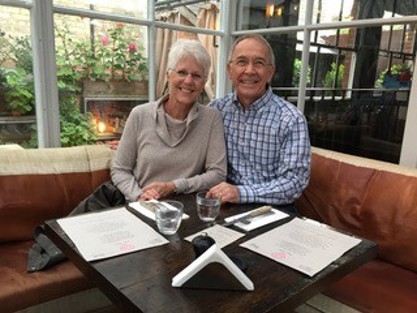
Ed and Kathy in Gee’s Restaurant in Oxford, during a visit in 2016 when Ed was consulting with the NHS.
South Carolina & St John's 1974
Born in Raleigh, North Carolina in 1952, Ed Coffey studied at Wofford College before going to St. John’s College, Oxford to read for a second undergraduate degree in psychology, philosophy and physiology (PPP). He returned to the US and obtained his medical degree from Duke University, where he also completed residencies in neurology and psychiatry. As Chair of Psychiatry for the Henry Ford Medical Group, Coffey pioneered the Henry Ford Hospital System’s ‘Perfect Depression Care’ programme which saw an unprecedented decrease in suicide levels. From 2014 to 2017, he served as President and CEO of the Menninger Clinic. Now in semi-retirement, Coffey continues to work in consulting in the academic and healthcare spheres. This narrative is excerpted from an interview with the Rhodes Trust on 2 September 2025.
‘We were very fortunate to have such an incredible mother’
I was one of three children and we lived with my parents in Salisbury, North Carolina in a small cabin behind the home of my maternal grandmother. My mother worked as a bookkeeper. My father had joined the US Army and been badly wounded during World War Two. It’s clear to me now that he suffered from really severe PTSD complicated by alcohol misuse. There were times when he would just, sort of, be absent from the family. Then he would come back and things would seem normal for a time, but it was incredibly stressful, in particular for my mother.
The summer after my fifth grade, my father decided we would move to the South Carolina coast. We’d been down there about two years when he was killed in a boating accident. At that point, things were really tough. My mom was completely on her own with three kids. Then, she met Jimmy, the man who eventually came to be our stepfather, and things settled down a good bit. We were very fortunate to have such an incredible mother and to be taken in by a really incredible stepfather as well.
I enjoyed school and I was always an avid reader. I attended a very small high school with only 250 students from the seventh through to the twelfth grade and because it was so small, all of us played all the sports. I also got involved in a little rock and roll band, and we had a lot of fun. In high school, the guidance counsellor pulled me aside in my senior year and said, ‘We need to talk about college.’ He got me applying for a variety of scholarships and the one that hit was an Army ROTC scholarship. I could have gone anywhere in the country that had an ROTC programme, and I chose Wofford, because it was in South Carolina and I wanted to stay close to help out my family.
On applying for the Rhodes Scholarship
Just as I was about to go to Wofford College, the Kent State massacre happened. I realised I couldn’t willingly go and lead troops in Vietnam. The ROTC commander was very supportive and understanding, and I was honourably discharged me with no obligations. Wofford helped me put together loans and work study and scholarships and I was able to continue my education there. I had an incredible training in psychology there and I was all set to go to graduate school when my future father-in-law took me aside and told me I would have much greater research access to people and to patients if I did an MD as opposed to a PhD. That’s how I decided to go to medical school, and it was absolutely the right decision.
In the fall of my senior year, the dean of the college said that they would like me to consider applying for the Rhodes Scholarship. By that time, I had met Kathy, my future wife, and we were planning to get married. Back then, you couldn’t be married in your first year as a Rhodes Scholar. The dean talked to Kathy and said, ‘You’re not going to be able to get married next Spring as you’re planning,’ and she said, ‘That’s not a problem: he’s not going to win it anyway.’ So, I wrote my application and went down for the interviews. I didn’t do any kind of preparation and I didn’t think I had even a remote possibility of getting it. But I guess the good part was that I wasn’t really anxious. When I won the Scholarship, I was stunned, as was Kathy. She met me at the airport and said, ‘Well, I guess we’re going to England.’
‘The exchange of perspectives is what the Scholarship is all about’
Kathy and I planned that she would stay in the US while I did my first year, but being apart really wasn’t working, so I spoke to the Warden of Rhodes House and he and his wife were very generous in helping Kathy get a job as a nursing auxiliary at the Radcliffe Infirmary. That summer, we flew home and got married and then I interviewed at medical schools before returning to Oxford.
Living in Oxford was an incredible opportunity. It was so cosmopolitan, and I made friends with people from all over the world. The exchange of ideas and the exchange of perspectives is what the Scholarship is all about, but I didn’t appreciate it until I began experiencing it. Alongside that, the learning at Oxford wasn’t all neatly packaged the way it was in the US. You had to be pulling from a variety of different areas of information the entire time you were there, and synthesising that and putting it together was an incredibly important skill.
‘The whole notion of zero suicides became a way to transform healthcare systems’
We knew we wanted to go back to the US, and I was very fortunate to be accepted at Duke University School of Medicine. Kathy also got a very good opportunity there doing research in the cardiovascular database. I had a really challenging first year, cramming all the science work in, but that meant I could start seeing patients in our second year. I became aware that I was profoundly interested in why we behave the way we do. I decided to pursue neuropsychiatry, to understand not just behaviour but the interaction between our emotions, thoughts and feelings and how the brain works. The early years of my career are a bit of a blur. As junior faculty, you’re working as hard as you can, and then, Kathy and I were also starting our family. So, again, thank God for mothers. It’s hard enough being married to a medical student and a resident, but to have little children entering the picture, that is a really, really heavy lift.
While I was at Duke, my team created programmes in neuropsychiatry and in brain stimulation that served as models for an academic setting. After six years on faculty at Duke, I was recruited to the Allegheny Health System in Pittsburgh to help lead a neuropsychiatry institute which it had just created.
After that, I went to Henry Ford in Michigan. At that time US healthcare was struggling with quality and financial challenges. To address these challenges, my team participated in a national grant-funded initiative to rapidly achieve dramatically higher levels of healthcare performance by pursuing “perfection or zero-defect” goals. We convened groups to talk about what “perfect” depression care would look like, and one of our nurses suggested that if we were doing perfect depression care, maybe nobody would kill themselves. No one spoke for a long time, and then one of the senior clinicians said that if somebody wanted to kill themselves, we couldn’t possibly stop it. We decided that, although he might be right, zero suicides must be our goal, and that moment transformed our department. Ten years later, we had achieved a level of suicide reduction that was unparalleled in the scientific literature. We taught other organisations how to do the same, and the whole notion of “zero suicides” has become an international movement recognized as a model to transform healthcare systems.
After nearly two decades at Henry Ford Health System, I spent the next 3 years in Houston as President and CEO of the Menninger Clinic, to assist the clinic with its relocation from Kansas to the Baylor College of Medicine in Houston. Kathy and I then moved back South to be closer to her parents, who were beginning to decline in health at that time. It was good to be back home in South Carolina, and I have an incredible family. Kathy and I have three children and all of them are married and have children of their own, so we have six grandchildren who keep us occupied.
I am semi-retired now, but I remain active as a healthcare leadership advisor regarding neuropsychiatric care as well as general healthcare system design. The field hasn’t made nearly the amount of progress in healthcare quality that our patients and community deserve, and it’s that opportunity for improvement that continues to drive me.
‘I do like the notion of being kind and being brave’
I was involved in Rhodes Scholarships selection committees for years and I was always in awe of the level of talent and accomplishment of the candidates, thinking, ‘How in the world could I possibly have been part of this group?’ I don’t have a whole lot of advice to offer today’s Rhodes Scholars, but I do like the notion of being kind and being brave. I think if we can really be kind to people, seek to listen, seek to understand, be humble in our beliefs, then we have an opportunity to reach common ground. From there it's a matter of being brave enough to do the right thing – this is how we can make a positive difference.
This interview contains mentions of suicide. Viewer discretion is advised.